The strategy document is usually excellent. It's well-researched, clearly written, and logically coherent. It identifies the right problems, proposes sensible approaches, and builds a compelling case for why digital transformation is necessary. Then it gets presented, approved, and quietly abandoned.
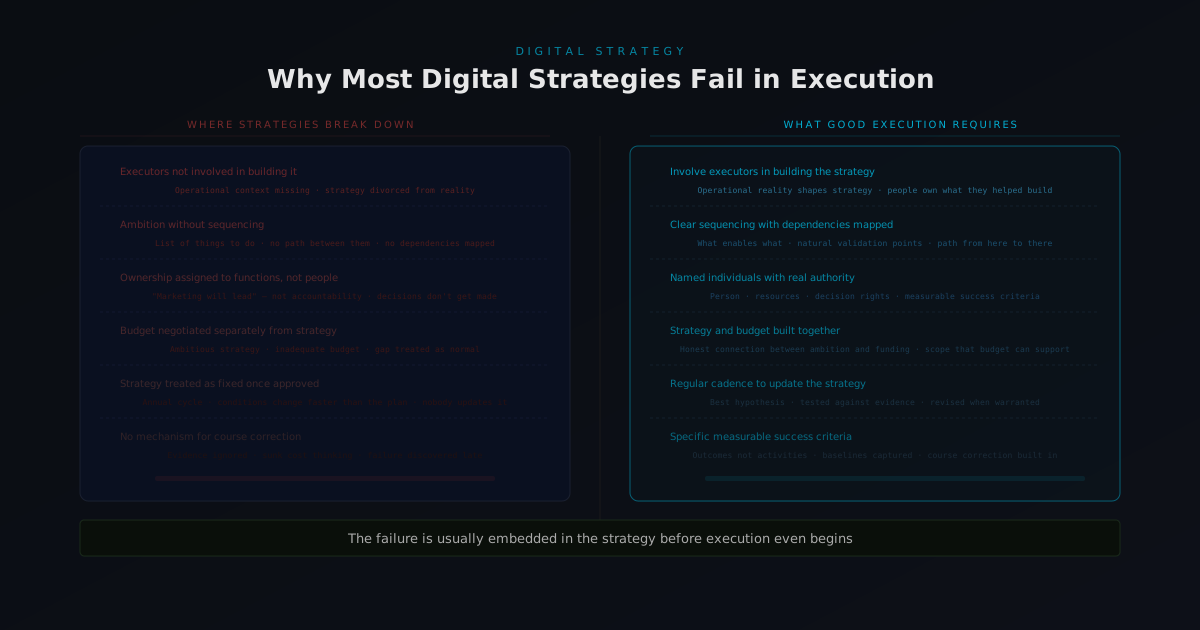
This pattern is so consistent across organisations that it's worth asking whether the problem is with execution discipline or with something structural about how digital strategies are built. The answer, after watching many of them, is mostly the latter. The failure is embedded in the strategy before execution even begins.
The gap is usually built in from the start
Most digital strategies are built by a small group of people, often a leadership team, sometimes augmented by a consultancy, who analyse the situation, identify opportunities, and produce a document that represents their conclusions. The people who will execute it are rarely involved in building it.
This creates several problems simultaneously. The people doing the work often have context that the strategy-writers don't, about what's actually possible with current systems, what the real operational constraints are, what customers actually want. That context doesn't make it into the strategy. When the strategy then arrives as a set of directives, the people executing it can see immediately why elements won't work as planned, but they weren't in the room when the decisions were made, and often feel they have no standing to say so.
The fix is structural, not cultural: involve the people who will execute it in building it. Not as stakeholders to be consulted after the fact, but as genuine contributors to the strategic design. The strategies that survive contact with reality are the ones that were tested against reality during their creation.
Ambition without sequencing
Digital strategies tend to be ambitious, which is fine. The problem is that ambition without sequencing creates a list of things to do rather than a plan for doing them. Every initiative is important. Every capability is required. There's no clear path from where the organisation is now to where it wants to be.
Execution requires sequencing. Which things need to happen first before other things become possible? What are the dependencies? What creates the foundation that everything else builds on? A strategy that doesn't answer these questions leaves execution teams to figure it out for themselves, and when they do, they often figure it out differently from each other, creating inconsistencies that fragment the effort.
Good sequencing also creates natural validation points. If the first phase needs to deliver X before phase two begins, you get an early signal about whether the approach is working. If you don't sequence, you don't get that signal until much later, usually after significant investment has been made in the wrong direction.
Ownership is abstract
Strategies routinely assign ownership to functions rather than people. "Marketing will lead customer experience." "Technology will own platform development." These are not accountabilities, they're departments.
Real accountability is a named individual with the authority to make decisions, the resources to act on them, and clear criteria for what success looks like. When ownership is abstract, decisions don't get made. When something is hard or politically complicated, nobody has the standing to push through. When things go wrong, there's no one to own the course correction.
This is uncomfortable to address because it requires being explicit about who is accountable for what, and that means the people in those roles have to own the outcomes, not just the activities. Most organisations resist this level of specificity. It's the specificity that makes execution work.
The budget doesn't match the strategy
Strategies are approved. Budgets are negotiated separately. The strategy says "invest significantly in platform modernisation" and the budget says "here is a number that represents the outcome of a negotiation that didn't take the strategy into account."
The result is a strategy that was never properly resourced, executing against a plan that was never realistic, producing results that were never going to match the ambition. The failure gets attributed to execution when the actual problem was that nobody made an honest connection between what the strategy required and what the organisation was willing to fund.
The discipline that prevents this is forcing the strategy and the budget conversation to happen together. What does this initiative actually require to have a reasonable probability of success? If the organisation won't fund that, it's better to narrow the scope of the strategy than to approve an ambitious strategy with an inadequate budget and pretend the gap doesn't exist.
The strategy doesn't change when reality does
Digital strategy is typically produced annually, presented, approved, and then treated as fixed until the next planning cycle. But the conditions the strategy was built for change faster than the strategy does. A competitor does something unexpected. A technology matures faster than anticipated. Customer behaviour shifts. The strategy that was right in January may be wrong by June.
Organisations that execute well on digital strategy have a mechanism for updating the strategy when significant new information arrives, not annually, but whenever the evidence warrants it. This requires a different relationship with the strategy document: not as a commitment to be honoured but as a current best hypothesis to be tested and revised.
What good execution actually looks like
The digital strategies that actually deliver tend to share a set of characteristics. They're specific about what success looks like in measurable terms. They're honest about dependencies and sequencing. They assign real accountability to named individuals. They're sized to match the budget that will actually be available. And they have a mechanism for adaptation, a regular cadence where performance against the strategy is reviewed and the strategy is updated if necessary.
None of this is complicated in principle. It's just harder and more uncomfortable than writing a strategy document that everyone agrees with and nobody is quite accountable for delivering. The discomfort of getting specific upfront is much lower than the cost of a failed strategy at scale.