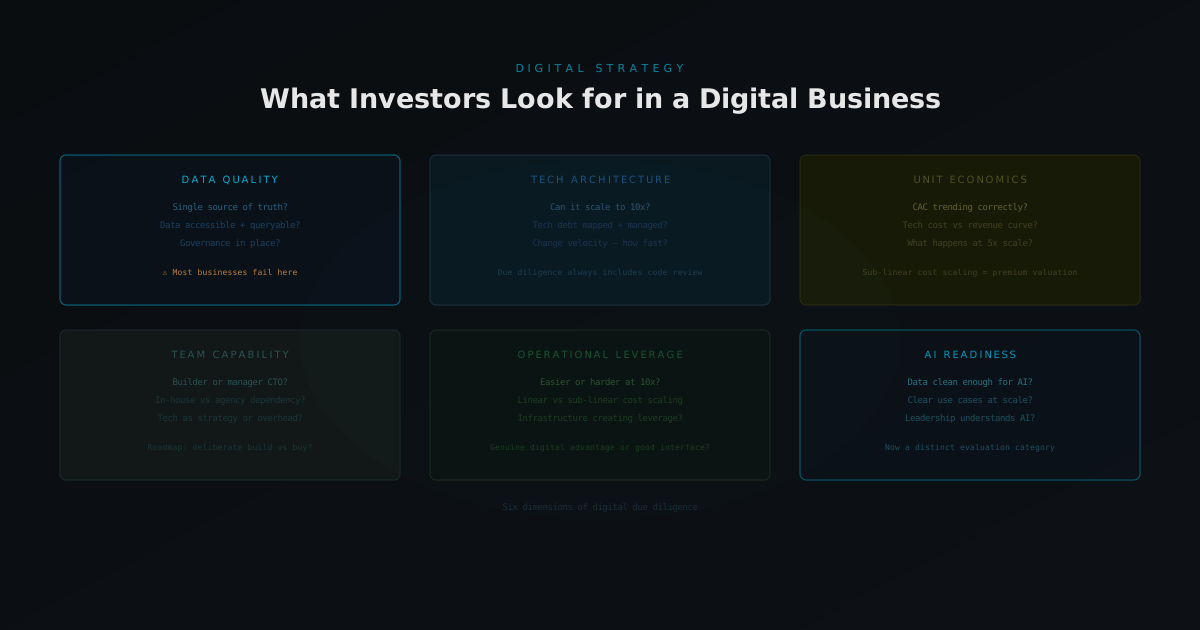
When a sophisticated investor looks at a digital business, they are not primarily looking at the product. They're looking at the infrastructure, the data, the team capability, and, increasingly, the AI readiness that will determine whether the product can grow into something worth holding.
Most founders prepare for due diligence by polishing their financials and sharpening their pitch narrative. Fewer prepare for the questions that actually reveal digital maturity, the questions that separate businesses with genuine digital capability from businesses with a good interface on top of a fragile foundation.
Data quality and ownership
The first thing serious investors probe is data. Not the headline metrics, those come from the deck. The underlying question is: does this business actually know what's happening inside it? And does it own the data that will be valuable as AI becomes central to operations?
Red flags investors look for:
- Data locked inside SaaS tools the business doesn't control or can't export cleanly
- No single source of truth, multiple systems with conflicting numbers
- Customer data that can't be queried without manual extraction
- No clear data governance, nobody owns data quality or data access
What good looks like is a business that can answer almost any operational question from its own systems, has a clear understanding of its data structure, and has thought about what data it needs to collect to support future capabilities, including AI.
Technology architecture and tech debt
Technical due diligence is real, and it often happens through a specialist firm or CTO brought in by the investor. What they're assessing is not whether your stack is impressive, it's whether it can scale, and at what cost.
A legacy monolith held together with custom integrations is not inherently a problem. But it becomes a problem if the investor's growth plan requires the platform to do things it structurally can't do, or if the cost of change is so high that velocity will be permanently impaired.
The most important thing you can do before a raise is to have an honest internal view of your tech debt, where it is, what it's blocking, and what the remediation plan looks like. Investors can handle bad news if it's accompanied by clear-eyed analysis. What they can't handle is discovering problems that management clearly didn't know about.
Unit economics and digital cost structure
Digital businesses often look better on gross margin than they actually are, because the costs of technology, cloud infrastructure, third-party APIs, SaaS subscriptions, are frequently categorised in ways that obscure their relationship to revenue.
Investors will look at customer acquisition cost in detail, including the digital channels, the attribution model, and whether the CAC is genuinely trending in the right direction as the business scales. They'll look at retention, and whether the product drives the kind of engagement that predicts long-term value.
They'll also look at what happens to unit economics at 3x or 5x scale. A business where technology costs scale proportionally with revenue is a different investment from one where they scale sub-linearly, and most founders haven't stress-tested this clearly.
Team capability and digital leadership
The team question in a digital business is not just "is the product good?" It's "can this team keep building it, and can they adapt as the technical landscape shifts?"
Investors look at:
- Whether the CTO or Head of Product is a builder or a manager, both have different value at different stages
- Whether there is genuine in-house capability or whether the business is dependent on external agencies for core technology
- Whether the leadership team thinks about technology as a strategic asset or as an operational overhead
- Whether there's a clear view on what needs to be built vs. bought, and whether those choices have been made deliberately
Scalability and operational leverage
One of the most important questions in any digital business investment is: does this business get easier or harder to run as it grows? Genuine digital businesses get easier. The technology investment made early creates leverage, the same infrastructure can serve ten times the customers without ten times the cost.
If the business is showing signs of scaling linearly, where each new unit of revenue requires a corresponding unit of operational cost, that's a signal that the digital infrastructure isn't creating the leverage it should. Investors will model this carefully.
AI readiness
This has become a distinct evaluation category in the last 18 months. Investors aren't just asking "are you using AI?" They're asking whether the business is positioned to benefit from AI as a structural advantage over competitors.
The businesses that are best positioned are the ones with:
- Clean, accessible data that AI systems can learn from
- Clear use cases where AI can reduce cost or improve quality at scale
- Leadership that understands AI well enough to make informed investment decisions about it
- A data strategy that was built before the AI strategy, so the AI isn't constrained by poor data foundations
Businesses that are presenting AI as a feature rather than an operational capability tend to get probed harder here. The question isn't whether you've added an AI chatbot. It's whether the architecture, data, and team can turn AI into a durable competitive advantage.
What to do before you raise
The businesses that perform best in digital due diligence are the ones that have been managing their digital infrastructure as a strategic asset all along, not the ones that scrambled to clean it up before the process started. The scramble shows.
If you're 12–18 months from a raise, the most valuable thing you can do is conduct an honest internal audit across these dimensions. Identify the gaps, build a remediation plan, and start executing on it. Not to impress investors, but because a business with genuine digital maturity actually performs better.