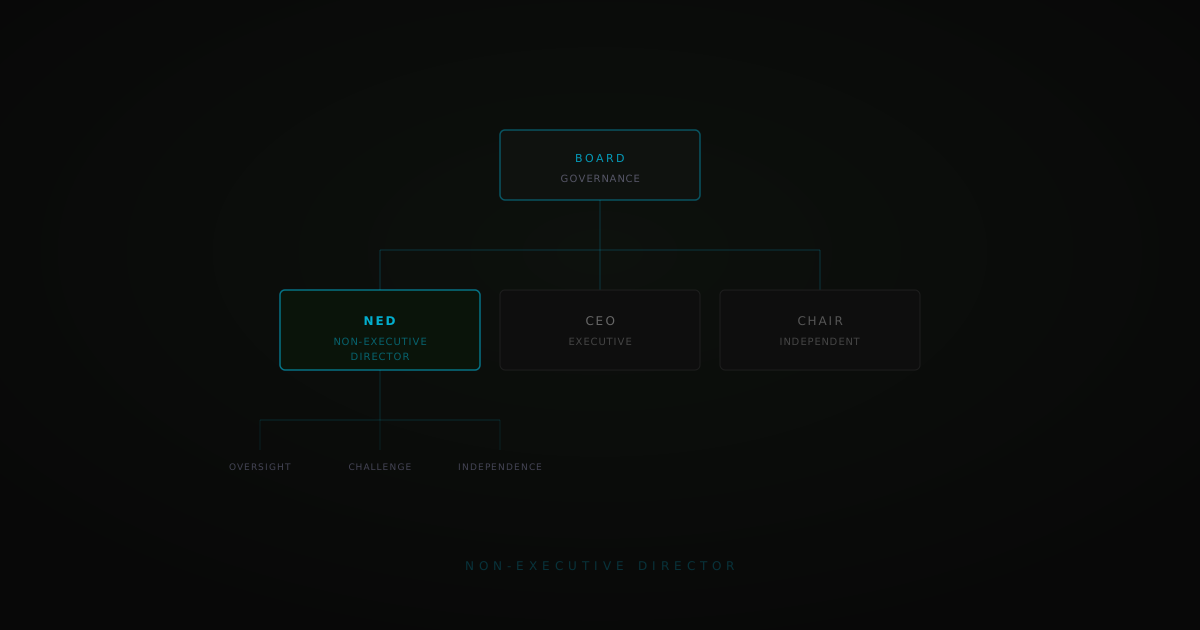
A Non-Executive Director (NED) sits on a company's board of directors but doesn't take part in day-to-day management. That's the textbook definition. But it tells you almost nothing about what the role actually involves, why it matters, or whether your business needs one. Having sat on boards as both an executive and a non-executive, and having helped founders recruit NEDs, I've found the confusion around this role is consistent — and expensive when it leads to the wrong hire or no hire at all.
The legal position first
This is the part that surprises most people. A Non-Executive Director, despite the "non-executive" prefix, carries the same legal responsibilities as an executive director under UK company law. They are a fiduciary. They owe duties of loyalty and care to the company. They can be held personally liable for decisions made at board level. They are subject to Companies Act 2006 director duties in the same way as the CEO.
This is not a minor technical footnote. It's the fundamental distinction between a NED and a board advisor. A board advisor gives opinions. A Non-Executive Director has legal skin in the game — and should be compensated and recruited accordingly.
"A NED and a board advisor are not interchangeable. One is a fiduciary with legal duties. The other gives opinions. Confusing the two is one of the most common governance mistakes in growth-stage companies."
What a NED actually does
The role sits across four broad functions:
- Challenge and scrutiny. The NED's primary job is to ask the questions the executive team might not ask of itself. Does this acquisition make strategic sense? Is the CFO's revenue forecast achievable? Are we moving into this market because it's right, or because the CEO is excited about it?
- Strategy input. A good NED brings pattern recognition from across sectors and stages. They've seen what works and what doesn't in ways that may be invisible to a management team living inside a single business.
- Governance and risk oversight. NEDs chair or sit on audit, remuneration, and nominations committees. They are the mechanism by which a company demonstrates accountability to shareholders, regulators, and other stakeholders.
- Network and reputation. An experienced NED brings a network — of customers, investors, regulators, talent — and their association with the business carries its own signal in markets where trust is scarce.
When does your business actually need a NED?
The honest answer is: later than most founders think, and much earlier than most corporates act. Here's a more practical frame.
You probably need a NED when:
- You have institutional shareholders who are requiring or strongly encouraging board governance
- You are preparing for a significant fundraise and want credible board representation as part of the story
- You are entering a regulated environment (financial services, healthcare, public sector) where governance credentials matter to customers and regulators
- You are a founder-led company where the executive team lacks experience in a critical domain (finance, technology, international expansion) that will determine the next growth phase
- You are approaching a transaction — IPO, acquisition, or significant M&A activity — that requires formal board governance
You probably don't need a NED yet when:
- You are pre-Series A and building product-market fit — your time and equity are better spent on advisors with relevant operational expertise
- You are looking for a "brand name" NED without clarity on what problem they solve
- You can't articulate what you need them to scrutinise, challenge, or contribute beyond their CV
The most common NED recruitment mistakes
Recruiting for prestige, not fit. Big names are appealing, but a former FTSE 100 CFO who has never worked in your sector or at your stage may contribute less than a less-decorated operator with directly relevant experience. Board credibility is built on useful challenge, not on impressive LinkedIn profiles.
Not agreeing on time commitment upfront. NED expectations vary enormously. Some roles expect quarterly board meetings and occasional committee work — four to six days a year. Others expect active involvement, monthly calls with management, and significant support around fundraising. If this isn't specified in the letter of appointment, the gap will surface at exactly the wrong moment.
Treating the NED as an ally rather than a check. The instinct of many founders is to find a NED who "gets it" — who broadly supports the direction of travel and won't create friction. This instinct is understandable and wrong. The value of a NED comes precisely from their independence. A NED who always agrees with you is a governance liability, not an asset.
How a NED differs from a board advisor
This is worth being explicit about, because the two roles are often conflated — especially at growth-stage companies that are building out their advisory infrastructure for the first time.
A board advisor has no legal duties to the company. They are not a director. They do not have fiduciary obligations. They provide input, make introductions, lend their name, and offer perspective — but they are not accountable for board-level decisions in any legal sense. They are typically compensated with small equity grants (0.1–0.5%) and have no formal place in the governance structure.
A Non-Executive Director is legally a director, carries all the attendant duties and liabilities, and is compensated as such — typically through a combination of a cash fee and, in growth-stage companies, equity. For a full breakdown of the differences, see the comparison of board advisor vs NED roles.
Finding the right NED
The recruitment process matters. The strongest NED relationships I've seen — on both sides — have started with a clear brief: what specific challenge is this person being brought in to help navigate? What does the board currently look like, and what's missing? What does the company look like in three years, and does this person have experience relevant to that version of the business?
The worst starts with: "We need a NED. Who do we know?"
Take references seriously. Talk to founders who have worked with the candidate as a NED, not just as a colleague or advisor. The ability to challenge constructively without creating dysfunction is a specific skill, and it's not universally distributed among experienced executives.
Thinking about board composition for your business?
If you're trying to work out whether you need a NED, an advisor, or something else entirely,
I'm happy to think through it with you →