This is the most common outcome. Not a falling out, just a quiet fading. And it's almost always avoidable, because the failure modes are predictable and set up in the first conversation.
I've been on both sides of this relationship across many years as the founder seeking help, and as the advisor being brought in. Here's what I've seen work, what doesn't, and what the conversation that sets it up properly actually looks like.
What founders get wrong
They recruit advisors for their name, not their relevance. An impressive CV on a pitch deck is not the same as someone who can help you with the problem you're actually facing this quarter. The question isn't "who would look good on our advisory board?" — it's "who has specific experience with this specific problem, and will they actually engage?"
They don't define what they need. "I'd love your input on the business" is not a brief. It invites generic advice and irregular engagement. The advisors who add the most value are the ones who've been given a specific domain, commercial strategy, technical architecture, regulatory navigation, a specific market, and asked to go deep on it.
They treat advisors like employees without the accountability. Expecting regular availability, quick turnaround on introductions, and attendance at internal meetings without a formal engagement, without a retainer, and with only a small equity stake, is a set-up for disappointment on both sides. Advisors are not fractional executives. The relationship works differently.
They stop calling when things get hard. The moments when founders most need an advisor, a bad board meeting, a key hire who didn't work out, a strategic decision with no good options, are exactly the moments when they're least likely to reach out, because they don't want to appear like they don't know what they're doing. This is the wrong instinct. The advisor is precisely the person you should call when it's hard.
What advisors get wrong
They overcommit at the start. The first call is energising. The problem is interesting. The founder is compelling. The advisor says yes to more than they can deliver, monthly calls, introductions, reviewing decks, and then real work intervenes. Managing expectations up front, about time, access, and the realistic shape of the engagement, is the advisor's responsibility.
They give advice instead of help. Telling a founder what they should do is not the same as helping them do it. The most useful advisors don't just share a perspective, they open a door, make a connection, sit in the meeting, review the actual document. The gap between "here's what I'd think about" and "let me introduce you to the person who can solve this" is enormous.
They stay in the wrong seat. An advisor who was valuable at pre-seed, helping with product-market fit, early team building, the first sales conversations, may not be the right person for the Series B conversation. The honest advisor recognises when they've reached the edge of their relevance and says so, rather than continuing to show up out of habit or loyalty to the equity stake.
"The best advisors I've worked with were the ones who told me when they were out of their depth, and then introduced me to someone who wasn't."
What makes it work
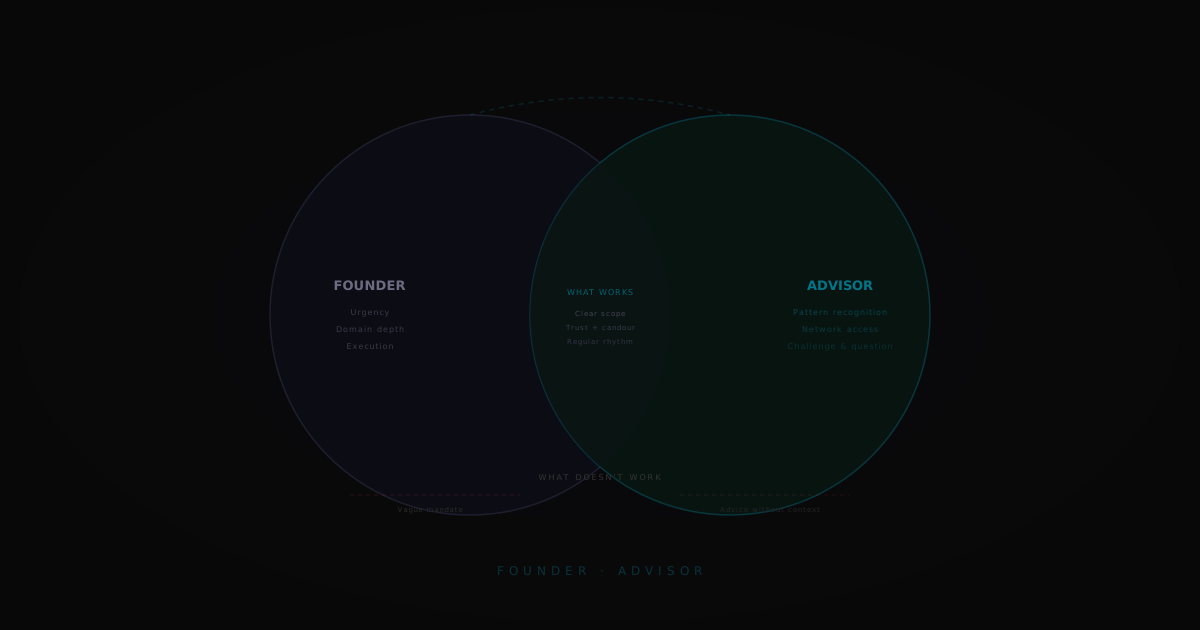
A specific brief. Not "advise on the business" but "help us think through our GTM strategy for the Spanish market" or "be the person I call when I have a technical architecture decision to make." Specificity sets expectations, focuses the engagement, and makes it much easier for the advisor to know when they're being useful and when they're not.
A regular rhythm. Monthly calls that happen, not "let's catch up when there's something to discuss." Without a rhythm, the relationship degrades into a reactive one where the founder only calls in a crisis and the advisor feels out of context. Thirty minutes a month, on the calendar, with a brief agenda shared 24 hours in advance, is enough to maintain continuity.
Honest updates in both directions. The founder tells the advisor what's actually going on, including what's failing. The advisor gives their genuine view, including disagreement. A relationship built on curated updates and polite encouragement is pleasant but useless. The value is in the unfiltered conversation.
A defined horizon. Not every advisor relationship should last forever. Building in an annual review, where both sides honestly assess whether the engagement is still valuable, is healthier than letting it drift until one party quietly stops responding. Some relationships should end. The good ones evolve.
The equity question
The standard advisor equity range sits between 0.1% and 0.5%, typically vesting over two years with a one-year cliff. The FAST agreement (Founder Advisor Standard Template) provides a clean, standard-form document that sets this up without legal complexity.
A few principles worth applying: equity should reflect real expected contribution, not title. An advisor who commits to four hours a month and two years of engagement earns more than one who will "be available when needed." Vest it properly, no advisor should receive equity without vesting. And be honest about whether the equity is compensation for work or a relationship signal. Both are legitimate; conflating them is where problems start.
When to formalise it
The most effective time to formalise an advisory relationship is after you've had two or three conversations that were genuinely useful, not before. Starting with a formal agreement before you know whether the relationship works inverts the process. Have the conversations first. If value is being created, formalise it. If it isn't, don't.
The formalisation itself doesn't need to be complex: a brief advisory agreement (the FAST or equivalent), a defined scope, a vesting schedule, and an honest conversation about what both sides expect. That's it. The rest is in the relationship, not the document.
Looking for an advisor who actually engages?
I work with a small number of founders and leadership teams each year. Let's talk →