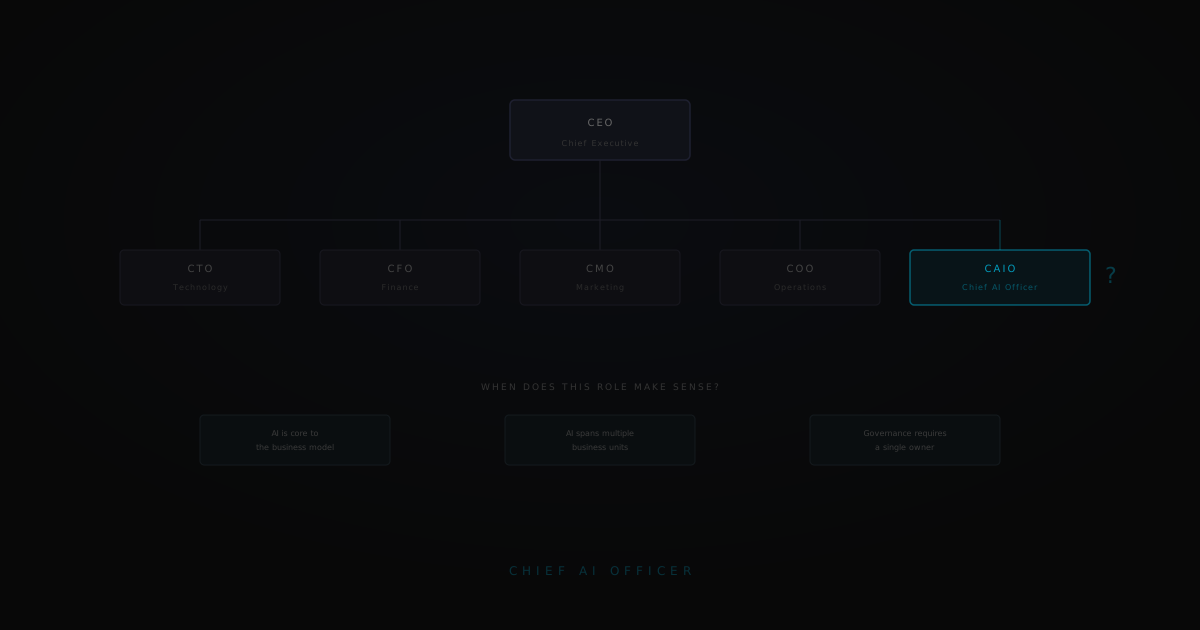
The data on CAIO appointments is striking. Several hundred organisations had a named Chief AI Officer or equivalent by the end of 2025, across sectors from financial services to healthcare to consumer goods. A substantial proportion of Fortune 500 companies have announced or filled the role. The pattern looks increasingly like the trajectory of the Chief Data Officer a decade ago: from exotic and optional to nearly standard for organisations of a certain scale.
But the CDO comparison is instructive for a reason that isn't flattering. Many CDO appointments over the last decade failed to deliver what they promised, not because the people were wrong but because the role was created without a clear problem to solve, and without the organisational conditions needed for the role to succeed. The same trap exists for the CAIO.
The problems the role is designed to solve
There are three specific organisational problems that a Chief AI Officer is genuinely well positioned to solve.
AI fragmentation. When AI initiatives are scattered across business units, each with their own tools, vendors, data approaches, and risk profiles, the organisation loses coherence. The same problems get solved multiple times. Governance is inconsistent. The cumulative spend is invisible to anyone. A CAIO creates a single accountable leader who can see across the whole portfolio, identify duplication, enforce standards, and concentrate investment where it creates the most value.
The translation gap between AI capability and business strategy. Many organisations have AI capability in their technology teams that isn't being translated into business value, and business priorities that aren't being addressed by AI when they could be. A CAIO whose mandate straddles both the technology and the business can close this gap in a way that a CTO (who typically reports to the business) or a CDO (who typically owns data infrastructure) cannot.
Governance and accountability at scale. When AI systems are making decisions that affect customers, employees, or regulated activities, the question of accountability becomes pressing. Who is responsible when an AI system makes a consequential error? In most organisations today, the answer is: no one clearly. A CAIO creates a named accountable leader for AI governance, which is increasingly what regulators and boards want to see.
"A CAIO doesn't just make AI go faster. They make it go in a direction the organisation has actually decided on, and they're accountable when it doesn't."
When not to hire one
The CAIO role is not the right answer if your organisation's AI activity is still at an early stage, primarily confined to one or two use cases, or if the primary challenge is technical capability rather than coordination and governance. In these situations, the role is likely to become a figurehead without real leverage, expensive, high-profile, and unable to do what the job description says.
It's also not the right answer if the CTO role is already effectively playing a strategic AI leadership function and doing it well. Creating a CAIO alongside an engaged CTO with genuine AI expertise creates ambiguity about who is responsible for what, and ambiguity at C-suite level is typically resolved by political attrition rather than organisational logic.
And it's not the right answer if the AI agenda hasn't yet been defined well enough to give the CAIO something to lead. The role requires a clear mandate, a set of problems it's accountable for solving. Without that, you're appointing someone to a role that the rest of the organisation hasn't agreed needs to exist.
The conditions for success
If the organisational problems match the role's design, then the conditions for success come down to three things. The CAIO must report at the right level, directly to the CEO or COO, not to the CTO. AI strategy is a business strategy matter, and embedding the CAIO inside the technology reporting line signals that it isn't.
The CAIO must have genuine authority over AI investment decisions across the organisation, not just advisory influence. If every AI initiative is separately approved by individual business unit leaders, the CAIO becomes a commentator rather than a decision-maker.
And the CAIO must have a clear success metric that the CEO and board can evaluate. What is this role accountable for delivering in the next 18 months? The answer to that question should exist before the hire, not after.
The alternative path
For organisations that aren't ready for a CAIO, the alternative is a formal AI governance structure without the dedicated C-suite role. An AI steering committee with cross-functional representation. A defined AI risk framework embedded in the risk committee. A clear AI investment process that runs through the CFO and CTO rather than a dedicated function. This is often more appropriate for organisations in earlier stages of AI maturity, and it creates the conditions under which a CAIO appointment would actually succeed, if and when the time comes.
Thinking through AI leadership and governance structure?
This is work I do with leadership teams and boards. Let's talk →