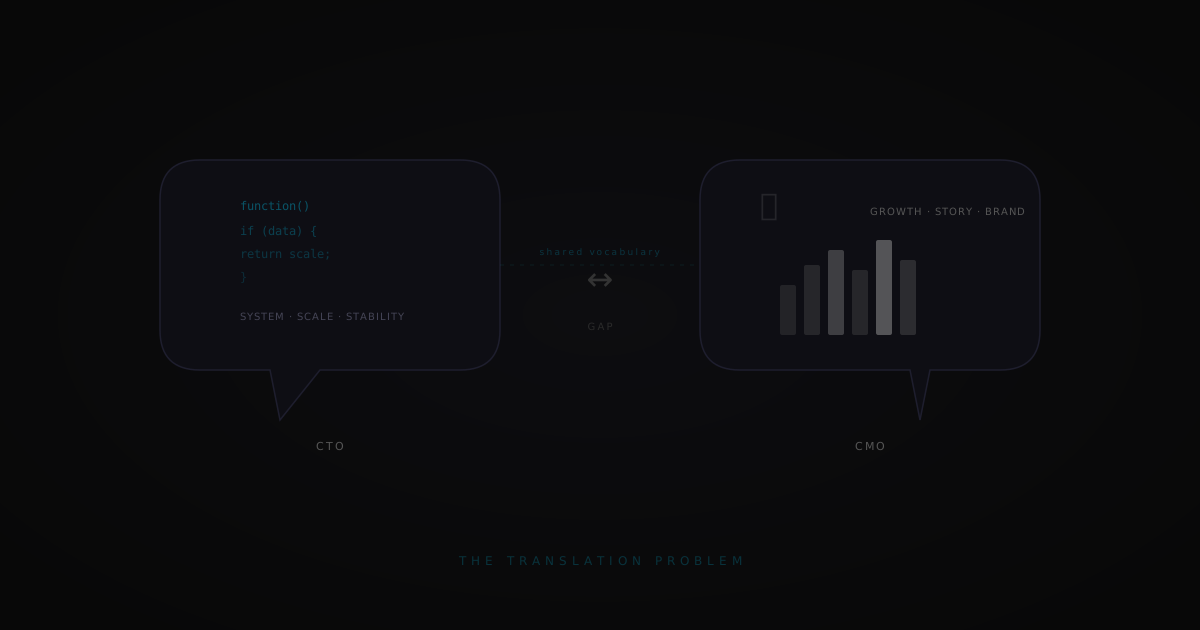
I once sat in a meeting where the CTO presented a plan to consolidate the customer data infrastructure, and the CMO responded that they were excited to see the new brand campaign. They had both been in the same room for forty-five minutes. They had heard different presentations.
This is not a failure of intelligence. It's a failure of translation. CTOs and CMOs are often excellent at their jobs and genuinely committed to the same business outcomes. The problem is that they have developed entirely different mental models for thinking about how businesses work — and those mental models are not naturally compatible.
How they actually think differently
The CTO's mental model is fundamentally architectural. When they see a problem, they think about systems: inputs, outputs, constraints, dependencies. When they propose a solution, they think about stability, scalability, and what breaks first under load. When something goes wrong, they look for root cause. Their language is technical, precise, and focused on what is true — what the system does, not what we wish it did.
The CMO's mental model is fundamentally narrative. When they see a problem, they think about people: what they want, what they fear, what story will move them. When they propose a solution, they think about cut-through, differentiation, and emotional resonance. When something goes wrong, they look for the story that will recover trust. Their language is interpretive, contextual, and focused on what is felt — what the brand means, not just what it does.
Neither model is wrong. Both are incomplete without the other. The problem is that most leadership teams have never built a bridge between them.
Where the dysfunction shows up
The translation failure between CTO and CMO tends to be invisible most of the time and catastrophic occasionally. Three places where it shows up most reliably:
Roadmap discussions. The CTO presents a roadmap structured around technical milestones — infrastructure debt, API migrations, platform consolidation. The CMO hears none of the commercial value. The CMO presents a roadmap structured around campaigns and customer journeys — launch windows, seasonal peaks, audience segments. The CTO sees no connection to what the technical team is being asked to build. Both roadmaps get presented to the CEO, who can't reconcile them, and nothing gets properly prioritised.
Data conversations. The CTO says "we need to clean the data before we can trust the outputs." The CMO hears "more delay." The CMO says "we need to understand our customer better." The CTO hears "build another dashboard." Neither understands what the other actually needs — and the data infrastructure decision gets made on the basis of the relationship, not the problem.
AI initiatives. This is where the language gap currently does the most damage. The CTO understands what AI can and cannot do at a technical level — the failure modes, the training requirements, the integration complexity. The CMO sees what AI has done in other businesses and wants to know why theirs is slower. The gap produces either over-promising (the CMO announces AI features that aren't technically feasible) or under-investment (the CTO deprioritises AI use cases because they can't be scoped properly from the commercial descriptions).
The gap between technology and commercial leadership isn't about trust. It's about translation. And translation is a skill that can be built.
Three fixes that actually work
Fixing the translation problem doesn't require restructuring the organisation or replacing either person. It requires three deliberate changes to how the two functions engage.
Build a shared vocabulary. Agree on a small number of terms that both functions use consistently. Not technical jargon, not marketing language — business language. What does "customer" mean (the paying entity? the end user? the decision maker in a B2B sale)? What does "launch" mean (code deployed? marketing live? customer access enabled)? What does "success" mean for a given initiative? These definitions sound obvious until you're in the meeting where the CTO and CMO are both saying "the launch" and meaning different things.
Build shared metrics. The most effective bridge between technical and commercial leadership is a metric that both functions feel accountable for. Not "engineering velocity" and "brand awareness" — those are siloed metrics that produce siloed decisions. A shared metric like "time from customer request to fulfilment" or "percentage of orders completed without manual intervention" forces both functions to understand how their work connects. When the number moves, both teams have to understand why.
Build a shared enemy. The most underrated alignment mechanism in any organisation is a problem that everyone agrees is genuinely bad. Not "we need to grow faster" — that's too abstract. "We lose 12% of customers in the 30-day post-purchase window and nobody knows why" is a shared enemy. Both the CTO (data infrastructure, event tracking) and the CMO (lifecycle marketing, win-back campaigns) have something to contribute. The shared enemy forces translation because both functions have to understand what the other is doing to solve it.
The role of the CDO — and when it helps
One reason the Chief Digital Officer role exists is to provide a translation layer between technical and commercial leadership. The CDO typically has enough technical literacy to engage credibly with engineering, and enough commercial orientation to connect with marketing and sales. Done well, the CDO doesn't duplicate either role — they fill the gap between them.
Done badly, the CDO becomes another silo. A third language that neither the CTO nor the CMO speaks. The translation problem doesn't disappear with a new title — it just gets a new name.
The real fix is building translation capability into the leadership team itself. That means CTOs who can explain what a technical decision means for customer outcomes. CMOs who understand what they're asking for when they request "more personalisation." And leaders at the top who can hold both conversations without defaulting to the one they find more comfortable.
It's not complicated. But it requires deliberate effort — and most leadership teams stop short of doing it.