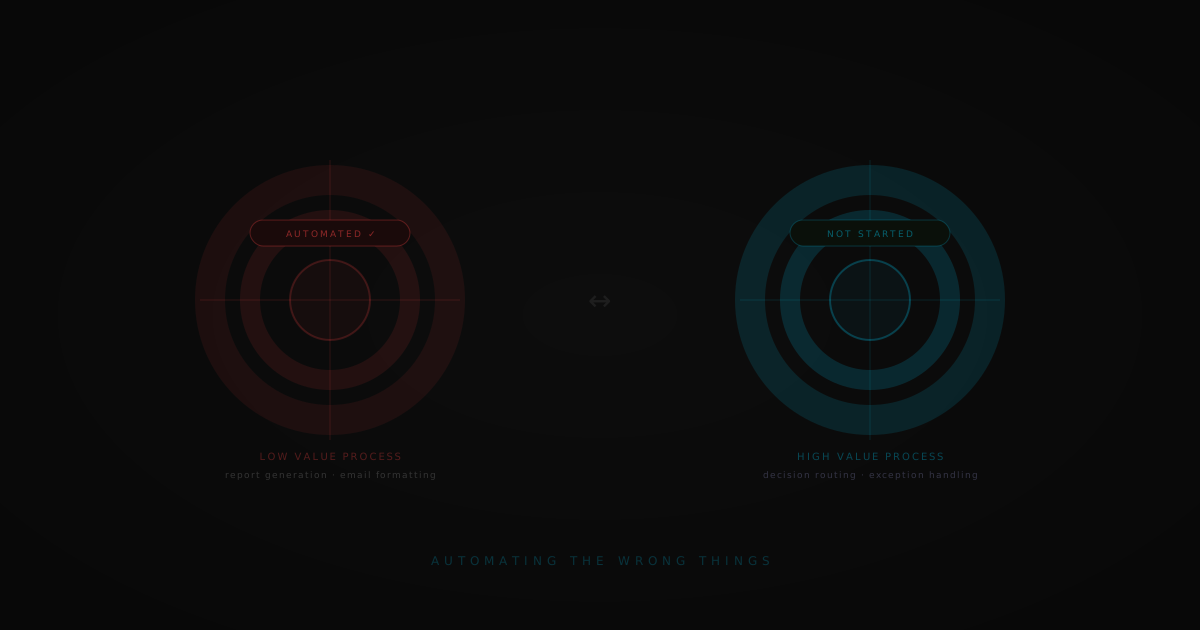
Every time I walk into a business and ask what they've automated, the answer follows a predictable pattern. Report generation. Email templates. Invoice processing. Scheduling. The things that are visible, repetitive, and easy to describe — and therefore easy to hand to an automation tool.
When I ask what they haven't automated, the answer is usually a long pause. Then: "Well, a lot of the decisions." Exactly. The high-friction, high-stakes, high-frequency decisions — exception routing, stock reordering, customer escalation prioritisation, dynamic pricing — are all still being made manually by people who are already stretched, using imperfect information, and doing it inconsistently.
The easy stuff got automated. The important stuff didn't. And the business wonders why it's still slow.
Why easy gets automated first
The selection bias toward easy automation is rational, not lazy. When a team is asked to show quick wins from their automation investment, they reach for things that can be described cleanly, built quickly, and measured simply. "We automated invoice processing and saved 40 hours a month" is a credible result. It can be demonstrated. It can be reported to the leadership team. It justifies the investment.
The high-value automation is harder to scope, harder to build, and harder to measure. "We automated exception routing in our supply chain operations" is a much more complex story. What counts as an exception? What are the rules? What happens when the rules fail? Who signs off? The conversation immediately gets complicated, and teams who are under pressure to show results often defer it.
The cumulative effect is an organisation that has saved hundreds of hours on low-value tasks and left the most expensive decisions — the ones that drive customer churn, inventory cost, and margin — exactly as they were.
Don't automate the tasks that are easy to describe. Automate the decisions that are expensive to get wrong.
How to find what's actually worth automating
The right question isn't "what takes time?" It's "what decisions are we making at high frequency that are expensive when they're wrong?"
High-frequency means the decision happens dozens or hundreds of times a day, every day. Expensive when wrong means the consequence of a bad decision — a customer escalating, a stock-out, a pricing error, an order routing failure — costs more than the time it takes to make the decision correctly. Decisions that meet both criteria are the correct targets for automation. Decisions that only meet the first criterion (high frequency, low consequence) are candidates for streamlining or elimination, not automation.
In practice, the inventory of worth-automating decisions usually looks something like this:
- Customer support escalation routing — deciding which tickets need human attention and which can be resolved automatically
- Inventory reorder triggering — deciding when stock levels require a purchasing action, based on lead times, current sell-through, and seasonal patterns
- Pricing exception handling — deciding when a promotional price or a discount request falls outside standard rules and requires review
- Workforce scheduling adjustments — deciding when demand signals require staffing changes in time to act on them
None of these are easy to automate. All of them are worth it.
The automation audit that changes the conversation
The most useful exercise I've found is what I call the decision audit. For two weeks, ask every operational team to log every decision they make that required them to look at information, make a judgment, and take an action. Not tasks — decisions. At the end of two weeks, sort the log by frequency and consequence. The items at the top of both lists are your automation targets.
What you'll typically find surprises teams. The decisions that feel like "just how we work" — the daily pricing reviews, the exception queues, the escalation triage — turn out to be happening hundreds of times a week and costing significant time and consistency. The invoice processing that got automated last year was happening once a day. The exception queue was happening 150 times a day and nobody had counted.
Once the decisions are visible and quantified, the automation investment case becomes straightforward. The hard part is making them visible — because the high-value decisions are usually invisible. Not because they're hidden, but because they've been part of someone's job so long that nobody has looked at them as a process that could be changed.
The right order
Automate in this order: first, the decisions with the highest frequency and the highest cost of error. Second, the decisions that are currently creating bottlenecks. Third, the tasks that support those decisions. Last, the tasks that just take time.
Most businesses are doing it exactly backwards. But the reversal isn't complicated. It just requires someone asking the right question.