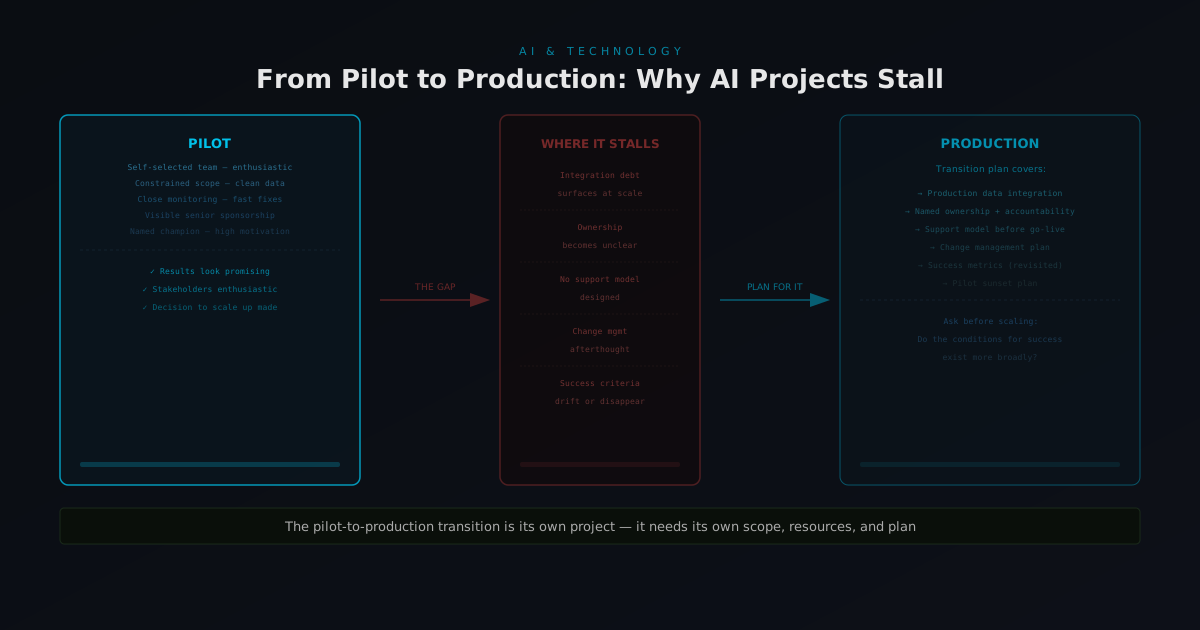
There's a phrase that appears more often than it should in AI postmortems: "the pilot worked well." Pilots do work well. They're designed to. The problem is that what makes a pilot work well is often precisely what makes the production transition fail.
This isn't a novel observation, but it's one that organisations keep ignoring, partly because the pilot success feels like validation of the whole approach, and partly because the problems only emerge later. Understanding the gap between pilot and production is the single most important thing organisations can do to improve their AI delivery rate.
Why pilots succeed
Pilots succeed because of conditions that don't exist in production. The team running the pilot is self-selected, enthusiastic, technically capable, and motivated. The scope is constrained, a specific use case, a specific team, a specific dataset. The monitoring is close, problems get caught and fixed quickly. Senior sponsorship is visible, resources materialise when needed.
None of these conditions transfer automatically to a broader rollout. In production, you're working with a general population that didn't choose to be involved. The scope is wider, touching more systems and more edge cases. Nobody is watching as closely. Senior sponsors have moved on to the next initiative. The conditions that made the pilot succeed have been removed.
The five places where the transition breaks down
Integration debt surfaces at scale. Pilots typically use clean, curated data and simple integrations. Production has to work with live data from multiple systems, inconsistent formats, missing fields, and the full range of exceptions that real operations generate. These integration challenges are predictable, they just don't appear in the pilot environment. The lesson is to design for production data from the beginning, not to discover its complexity at the end.
Ownership becomes unclear. During the pilot, there's usually a named champion, someone who cares about it and has made it their problem to solve. When the project moves to production, it needs a different kind of ownership: someone accountable for ongoing performance, who manages issues when they arise, and who can make decisions about the system's direction as requirements evolve. This person is often not identified before the transition, and the gap it creates is significant. Who owns it when it breaks?
The support model wasn't designed. Pilots don't need support models. Production does. When the AI system produces an unexpected output, who investigates? When a user doesn't understand why they've been given a particular recommendation, who explains it? When the underlying model needs to be updated because the environment has changed, who manages that? The answer to each of these questions needs to exist before go-live, not after the first incident.
Change management was an afterthought. Pilots typically involve a small group of willing participants who understand what they're testing. Production deployment reaches a much wider group who have been told to use a system they weren't involved in selecting. The gap in preparedness in understanding what the system does, what its limitations are, and how to use it effectively, is enormous. And unlike a software deployment, where you can write documentation, AI systems require a different kind of understanding: when to trust the output and when to apply judgment.
Success criteria drift. The pilot was evaluated against metrics defined when it began. By the time production deployment is underway, often six to twelve months later, the business context has changed, the stakeholders have changed, and the original metrics may no longer reflect what matters. But there's no mechanism to revisit them, so the project gets measured against criteria that are no longer fit for purpose, or not measured at all.
What the transition plan needs to cover
The pilot-to-production transition should be treated as a distinct project, not as an extension of the pilot. It requires its own scope, resources, and plan, covering at minimum:
- Integration architecture for production data, including all the edge cases the pilot didn't encounter
- Named ownership: who is accountable for the system's performance and who handles issues
- Support model: how users get help, how incidents are managed, how the system gets updated
- Change management plan: how production users will be onboarded, what they need to understand, how feedback flows back
- Success metrics: revisited and agreed for the production context, not inherited from the pilot
- A sunset plan for the pilot environment, to prevent the organisation running parallel systems indefinitely
The harder conversation
Some pilots should not go to production. The pilot worked in its controlled environment, but the conditions that made it work don't exist more broadly, the data isn't clean enough, the integration isn't feasible, the change management challenge is too large, the ROI doesn't justify production scale. Making this call requires honest assessment rather than sunk-cost thinking.
Organisations that are clear-eyed about this, that treat a pilot as a genuine test rather than as the first phase of a commitment, make better decisions about what to scale. Organisations that treat a pilot as a commitment they need to honour regardless of what it reveals end up with expensive production deployments of things that don't work.
The pilot worked. The question is whether the conditions for production success exist. Asking that question rigorously, before committing to the transition, is the most important thing you can do to close the pilot-to-production gap.