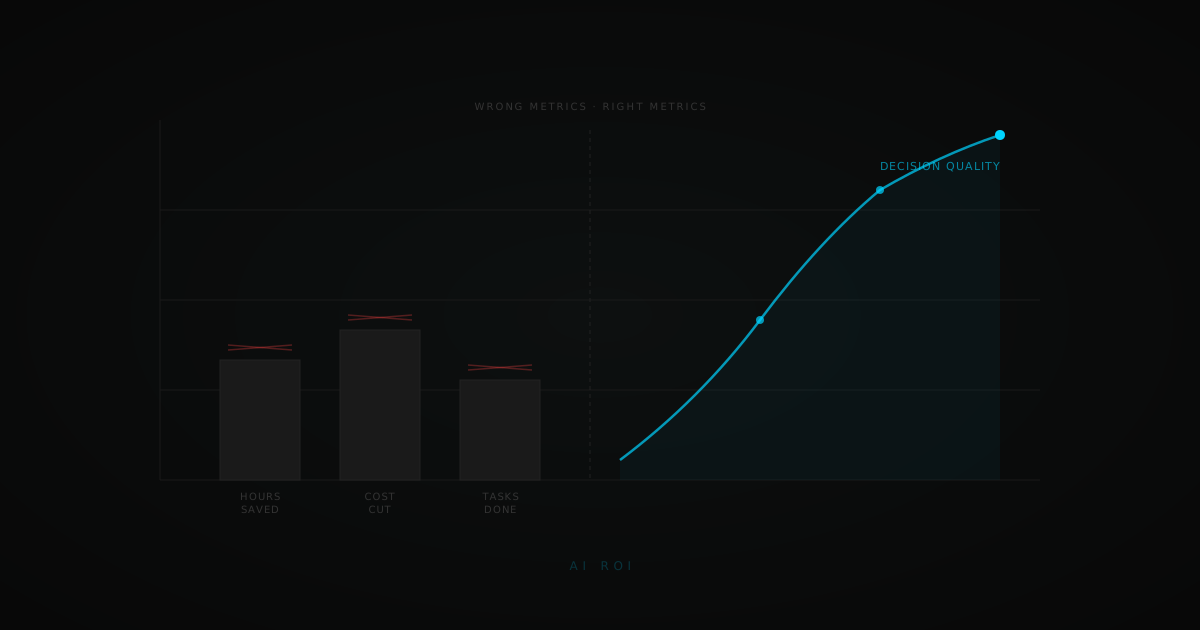
Every AI project I've seen go wrong had one thing in common: the business measured it the wrong way. Not the technology, the measurement. Teams would deploy an AI system, track hours saved or cost per transaction, declare it a success, and then wonder why nothing actually changed six months later.
The problem isn't the AI. It's what we're asking it to prove.
The standard frameworks are measuring the wrong layer
The default ROI model for AI is borrowed from process automation: count the hours a task took before, subtract the hours it takes now, multiply by a cost rate. If the number is positive, you win.
This made sense when AI was doing basic task replacement, routing tickets, generating templated emails, filling in forms. But as AI moves into decision-support and workflow intelligence, the "hours saved" model breaks down. It measures the task. It doesn't measure what the task was for.
Consider an AI system that helps a planning team make demand forecasting decisions. You can measure the time spent in the forecasting meeting, and yes, it probably went from two hours to forty minutes. But the thing that actually matters is whether the forecasts are more accurate and whether the business stopped over-ordering by 15%. That's not captured in hours. It shows up in inventory cost, waste, and margin. The time saving is real but it's a side effect, not the value.
Measure the outcome the AI is supposed to improve. Not the AI itself.
What AI actually changes — and where the value really lives
The meaningful impact of AI in business operations tends to show up in three places, none of which appear on a standard ROI spreadsheet until something breaks:
Decision speed. How long does it take from having the information to making the call? In most organisations, the bottleneck isn't data, it's the time between data existing and a decision being made. AI that compresses that window doesn't just save hours. It changes what decisions are even possible in a given timeframe.
Error reduction. Inconsistent decisions at scale are expensive in ways that are easy to overlook. When ten different people apply ten slightly different criteria to the same type of decision, the cumulative cost is real in rework, in customer experience, in regulatory exposure. AI that enforces consistency reduces that variance. You won't see it on a P&L line until you compare error rates before and after.
System reliability. The hardest thing to capture in an ROI model is the cost of NOT doing it. What does it cost when your pricing system fails to update overnight? When your stock position is wrong at 8am? When a customer complaint routes to the wrong team and sits for four days? AI that prevents these failures doesn't generate a visible return. It removes an invisible cost. That's genuinely hard to measure, but it's often the biggest number in the room.
The metric I actually use: time to decision
One number I've found useful across different types of AI implementations is time to decision, how long it takes from a triggering event to an action being taken. Not "how fast does the AI respond" (that's a technical metric), but "how long does the business take to act on what it knows."
Before AI: an anomaly appears in the data. Someone notices it in a weekly review. A meeting is scheduled. A decision is made three weeks later.
After AI: the anomaly triggers an alert. The relevant person is notified with context. A decision is made within four hours.
That compression is the value. Map it to the specific outcome it affects, reduced waste, faster recovery, better customer experience, and you have an ROI that actually means something.
Don't measure AI in isolation
Another mistake: treating the AI as a standalone thing to be evaluated. AI doesn't produce outcomes on its own, it produces outcomes when it's embedded in a workflow that someone acts on. Measuring the AI in isolation is like measuring the value of a dashboard by how fast it loads, not by whether anyone looks at it and changes their behaviour.
The right unit of measurement is the workflow the AI changed, not the AI itself. Before and after the workflow was redesigned to include the AI, what happened to the outcomes that workflow was responsible for?
A simpler framework
I use three questions before we deploy any AI system:
- What decision or outcome does this system support?
- How are we currently measuring that decision or outcome?
- What would a 10% improvement in that measure be worth to the business?
If you can't answer the second question, you're not ready to build. If you can't answer the third, you shouldn't be spending money on AI, you should be spending it on the measurement infrastructure that makes AI tractable.
The ROI of AI isn't hard to calculate. It's just usually in the wrong place. Start with the outcome. Work backwards to the AI. The number will follow.