The Chief AI Officer title is appearing on more org charts. Like every new executive role, it's being interpreted differently by different organisations, and often misunderstood by the boards appointing them and the teams they work alongside.
Before you hire one, redesignate someone, or create the role from scratch, it's worth being precise about what a CAIO actually does, and what they don't.
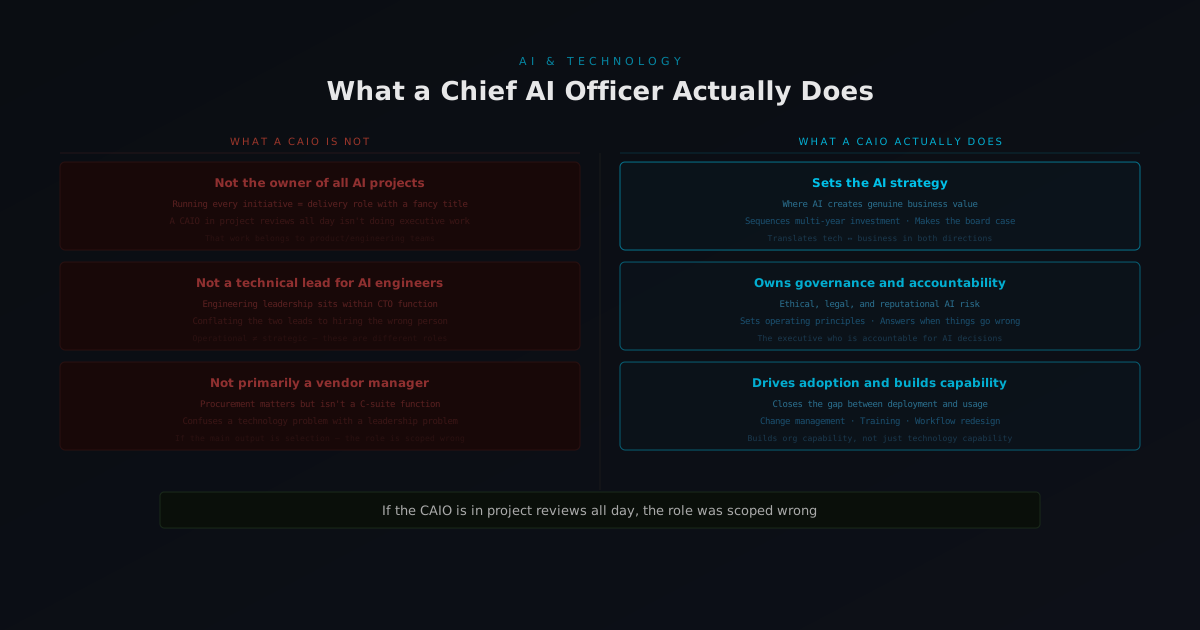
Not the owner of all AI projects. The most common misconception is that a CAIO runs every AI initiative across the business. That's a delivery role with an ambitious title. An AI officer spending most of their time in project reviews is probably not doing the strategic work that the executive level requires.
Not a technical lead for AI engineers. A CAIO is not the head of an AI engineering team. That sits within the CTO or Head of AI Engineering function. Conflating the two creates confusion about whether the role is operational or strategic, and typically leads to hiring the wrong person for one of them.
Not the organisation's AI vendor manager. Evaluating and selecting AI tools is important, but it's not a C-suite function in itself. If the primary output of the role is procurement, the organisation has confused a technology management problem with a strategic leadership problem.
Sets the AI strategy. A CAIO defines where AI creates genuine business value, sequences the investment across a multi-year horizon, and makes the case to the board and executive team. They translate between what the technology can do and what the business needs to achieve, and they do that in both directions.
Owns governance and accountability. AI decisions carry ethical, legal, and reputational dimensions that individual project teams are not equipped to navigate alone. The CAIO establishes the governance framework, sets the operating principles, and is the executive who answers for decisions made by AI systems when something goes wrong.
Drives adoption, not just deployment. Most organisations with AI tools haven't embedded them. The gap between deployment and active usage is where value is lost. Closing that gap through workflow redesign, training infrastructure, change management, and measurement, is core CAIO work. It's unglamorous. It's also where most of the value is.
Builds organisational AI capability. Not just technology capability, the people capability. Who has the skills? Where are the gaps? What learning infrastructure exists? How does the organisation stay current continuously rather than through one-off workshops every eighteen months?
A dedicated CAIO makes sense when:
If none of those are true, you probably need a strong AI lead within the CTO or CDO function, not a new C-suite role. Creating titles ahead of the business need they serve is expensive and sends the wrong signal to the organisation about what the role is actually for.
The best CAIOs operate mostly in the white space, building the connections between business units, technology teams, governance, and strategy that nobody else is positioned to make. They're translators, navigators, and conviction-builders as much as they are technologists.
They spend time with business leaders who are trying to understand what AI means for their function. They spend time with the board explaining risk and opportunity in terms that don't require a technical background. They spend time with frontline teams understanding what friction looks like in practice.
If a CAIO is spending most of their time in project reviews or vendor negotiations, something has gone wrong with how the role was scoped. The question to ask before creating the role is: what decisions will this person make, and what decisions will they influence? If the answer is unclear, the organisation isn't ready for the role yet.