The pattern has become familiar. A board approves an AI initiative, a significant investment in an AI platform, a deployment of generative AI across customer operations, an automation of a previously human process. The questions asked are about the business case and the budget. The questions not asked are about what happens when it goes wrong, what data the AI is trained on, who is accountable for its decisions, and how the board will know if the system is behaving as intended.
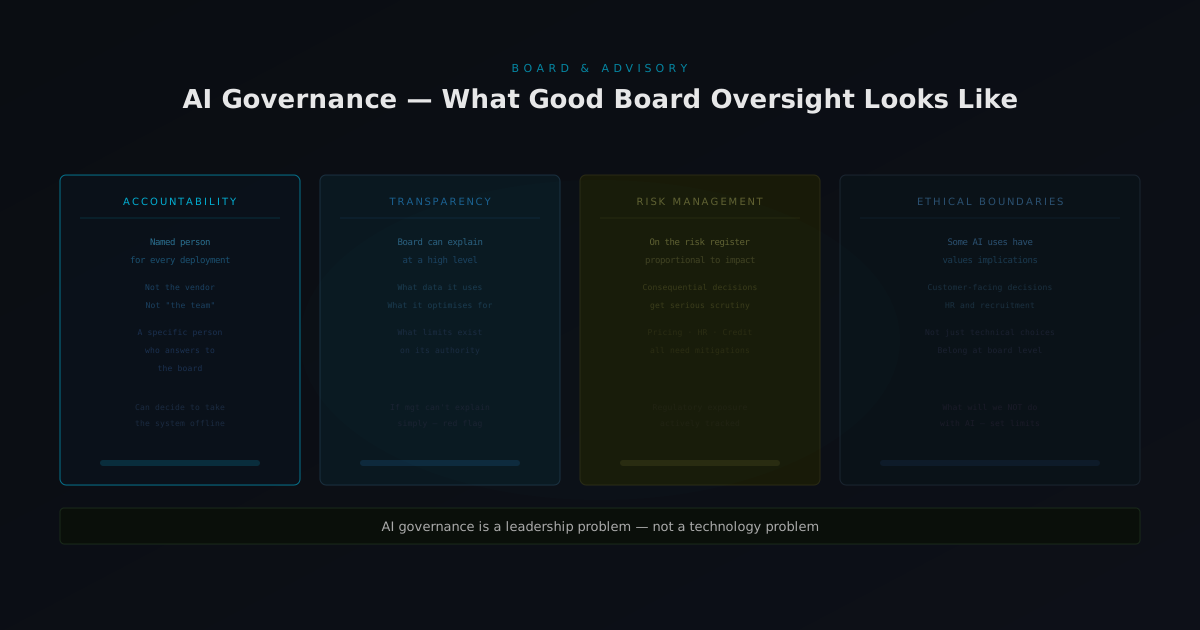
AI governance is not primarily a technical problem. It's a leadership problem. And the boards that manage it well are the ones that treat AI oversight as a distinct governance responsibility, not something that falls out of general technology oversight.
Why AI governance is different
Traditional technology governance involves overseeing systems that do what they are programmed to do. If a system behaves unexpectedly, there is usually a clear audit trail back to a decision a human made. The accountability chain is visible.
AI systems, particularly those using machine learning, behave differently. They learn from data, which means their behaviour changes over time. They make decisions that are difficult to explain. They can develop biases from training data that weren't intended and may not be noticed until they've caused real harm. And the accountability chain can be genuinely unclear, particularly in complex systems where multiple AI components interact.
This doesn't mean boards need to understand the mathematics of machine learning. It means they need a governance framework that accounts for these distinctive properties, one that creates accountability, requires transparency, and establishes meaningful limits on what the business will and won't deploy.
The four pillars of board-level AI governance
Accountability. Every significant AI deployment should have a named person who is accountable for its behaviour. Not the vendor. Not the team that implemented it. A specific individual in the business who can be questioned by the board and who is responsible for monitoring the system's outputs, investigating anomalies, and deciding when the system should be modified or taken offline.
Transparency. The board should be able to understand, at a high level, what data any significant AI system is using, what it is optimising for, and what limits have been placed on its authority. This doesn't require technical literacy, it requires management to be able to explain it in non-technical terms. If they can't, that itself is a governance signal.
Risk management. AI systems should appear on the risk register in proportion to their potential impact. An AI system making consequential decisions, about pricing, about customer selection, about resource allocation, deserves risk management commensurate with its scale. The board should have a view on which AI deployments pose the greatest risk and what mitigations are in place.
Ethical boundaries. Some uses of AI carry reputational, regulatory, or ethical risks that go beyond operational risk. Decisions about whether to deploy AI in certain contexts, customer-facing decision-making, HR processes, credit assessment, are not purely technical questions. They have values implications that belong at board level, not just with the product or technology team.
What questions boards should be asking
Practically, a board exercising good AI governance should be asking regularly:
- What are our most significant AI deployments, and who is accountable for each?
- How are we monitoring for unintended AI behaviours, and what does the escalation path look like?
- What data are our AI systems using, and do we have confidence in its quality and appropriateness?
- What decisions are we delegating to AI, and have we determined which decisions should remain with humans?
- How are we staying current with AI regulation in our operating jurisdictions?
The regulatory dimension
AI regulation is developing rapidly across multiple jurisdictions. The EU AI Act creates binding obligations for companies deploying AI in high-risk categories. Data protection laws in many countries impose specific requirements around automated decision-making. Financial regulators are increasingly scrutinising AI use in areas like credit and insurance.
Boards don't need to be regulatory experts. But they do need to have confidence that management is actively tracking the regulatory environment, that legal counsel is engaged, and that the business is not inadvertently building compliance exposure into its AI deployments.
Avoiding the two failure modes
There are two common failure modes in board-level AI governance.
The first is excessive restriction — boards that are so concerned about AI risk that they create governance processes so burdensome that the business falls behind its competitors and misses genuine value creation opportunities. This is a real risk, particularly for boards with limited digital experience.
The second is rubber-stamping — boards that approve AI investments without meaningful scrutiny, treating AI governance as a checkbox rather than a substantive responsibility. This is more common, and more dangerous.
The goal is a governance posture that is genuinely proportionate, rigorous oversight for high-risk, high-impact deployments, and appropriate delegated authority for lower-risk applications. Getting the proportion right requires board members to develop enough AI literacy to ask the right questions, not to answer them, but to know when the answers they're receiving are adequate.