Non-executive directors are increasingly expected to govern businesses where technology is central to strategy, operations, and competitive advantage. Most NEDs didn't come up through technology. Many feel quietly anxious about this gap. They shouldn't, but they do need a framework for how to engage with technology at board level without pretending to expertise they don't have.
What you actually need to understand
The first thing to get clear on is what you're not trying to do. You are not trying to become a technologist. You are not trying to evaluate code quality, architectural decisions, or engineering practices at a detailed level. That's not your job. Your job is governance, which means oversight, risk assessment, resource allocation, and accountability.
What you need to understand is whether the technology function is being led well. Whether the risks the business is taking are visible and intentional. Whether there's a coherent relationship between the technology strategy and the business strategy. And whether the people running it can explain their choices clearly.
Good technology governance is less about understanding the technology and more about understanding the quality of thinking behind it.
The questions that reveal most
The most useful diagnostic questions at board level are rarely technical. They're about clarity, honesty, and organisational health:
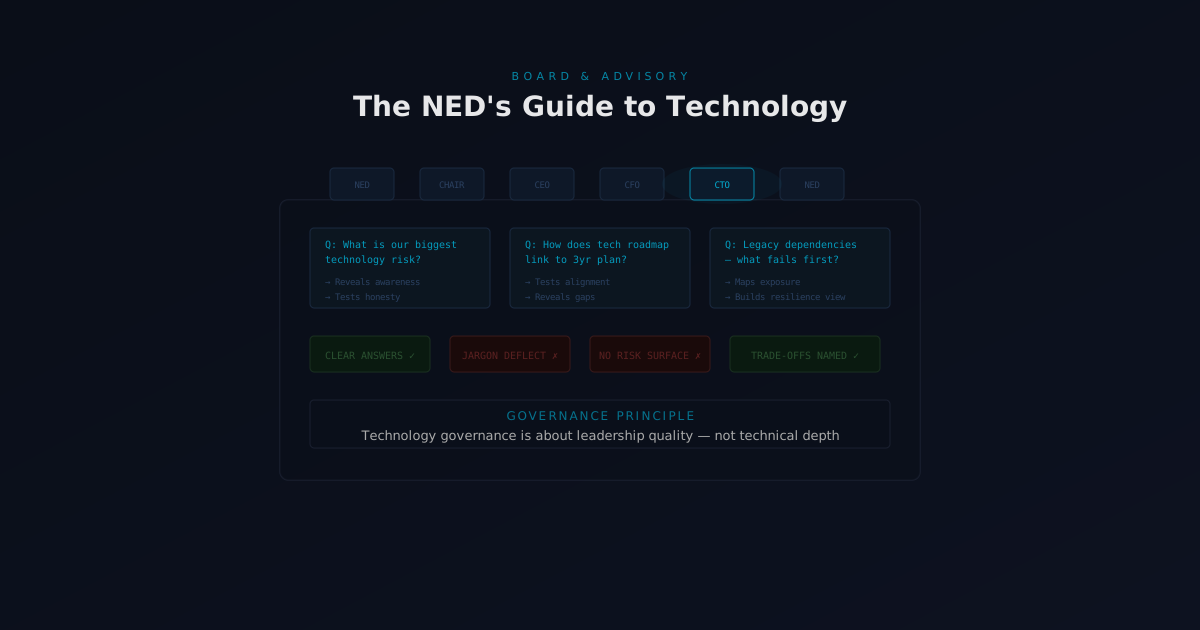
- What's the biggest technology risk in the business right now, and what are we doing about it?
- How does your technology roadmap connect to the three-year business plan?
- Where are we most dependent on legacy systems, and what happens if one of them fails?
- How do you know your team has the capability to deliver what you're planning?
- What would you change if you could start from scratch, and why haven't you?
The quality of the answers tells you a great deal. A CTO who can answer these questions clearly and honestly, including admitting uncertainty, is probably doing the job well. One who retreats into jargon or deflects with optimism is a yellow flag.
Red flags in technology presentations
Board presentations on technology tend to fall into recognisable failure patterns. Watch for:
Jargon without substance. If a presentation is full of buzzwords, cloud-native, microservices, AI-first, but light on what these mean for the business, that's not a sign of sophistication. It's often a sign that the presenter is more comfortable with the technology than with the business case for it.
Roadmaps without trade-offs. Every technology roadmap involves choices. If a roadmap is presented without explaining what was deprioritised and why, it's not a real roadmap, it's a wish list. Good technology leaders surface trade-offs. They don't pretend everything is possible.
Absence of risk. Technology carries risk: security, reliability, data, dependency on third parties. If a technology update to the board doesn't surface risk, either the presenter doesn't see it or doesn't want you to. Neither is acceptable.
How to read a CTO
The CTO (or equivalent technology lead) is the most important person you're assessing when evaluating the technology function. What you're trying to understand is whether they have the leadership capability the business needs, not just technical expertise.
The best technology leaders are translators. They can move between deep technical discussion and clear business language without losing coherence in either direction. They're comfortable with uncertainty and honest about what they don't know. They think about risk proactively rather than defensively.
A CTO who can't explain their decisions in terms a non-technical board can understand is either not thinking clearly about the business context, or is not willing to have their thinking scrutinised. Either is a problem at board level.
What good technology governance looks like
Effective technology governance at board level has three components. First, regular visibility into the technology risk landscape, not just what's being built, but what could go wrong and how prepared the organisation is. Second, a clear line of sight between technology investment and business outcomes. If the board can't connect the technology spend to business value, something is missing in the reporting.
Third, an environment where the CTO or technology lead can raise concerns honestly. Many technology crises that surprise boards weren't actually surprises, they were known risks that never made it upward. The board's job is partly to create the conditions where bad news travels fast.
Building your own framework
As a NED, you don't need to know everything about technology. You need a reliable set of questions, a sense of what good looks like in the answers, and the confidence to push back when something isn't clear. The goal isn't technical fluency, it's governance fluency applied to a technology context.
Build relationships with your technology leaders outside the boardroom. Read broadly, not technical publications, but strategic thinking about how technology is changing business. And don't be embarrassed to ask basic questions. The best boards create environments where no question is too simple, because simple questions often expose the most important gaps.