Every leadership team inherits tech debt. Most leadership teams underestimate what it actually costs them.
Tech debt is the shorthand developers use for code that was written quickly, without the architecture it would have needed if you'd known then what you know now. Some of it is unavoidable. You move fast, you make trade-offs, you ship something imperfect because shipping something imperfect is better than shipping nothing.
The problem is not the debt itself. It's what happens when you don't take it seriously as a strategic constraint.
What tech debt actually is
Tech debt isn't just messy code. It's anything in your technology layer that makes the next thing harder than it should be. It shows up as:
- Systems that can't be changed without breaking something else
- Integrations that are fragile and poorly documented
- Data models that don't match how the business actually works
- Infrastructure that was fine at 10,000 users and breaks at 100,000
- Codebase no one fully understands anymore
None of this shows up on a balance sheet. Which is why it tends to accumulate quietly until something breaks, or until a new hire says "this is really bad" and leadership realises they've been sitting on a ticking clock.
The real business impact
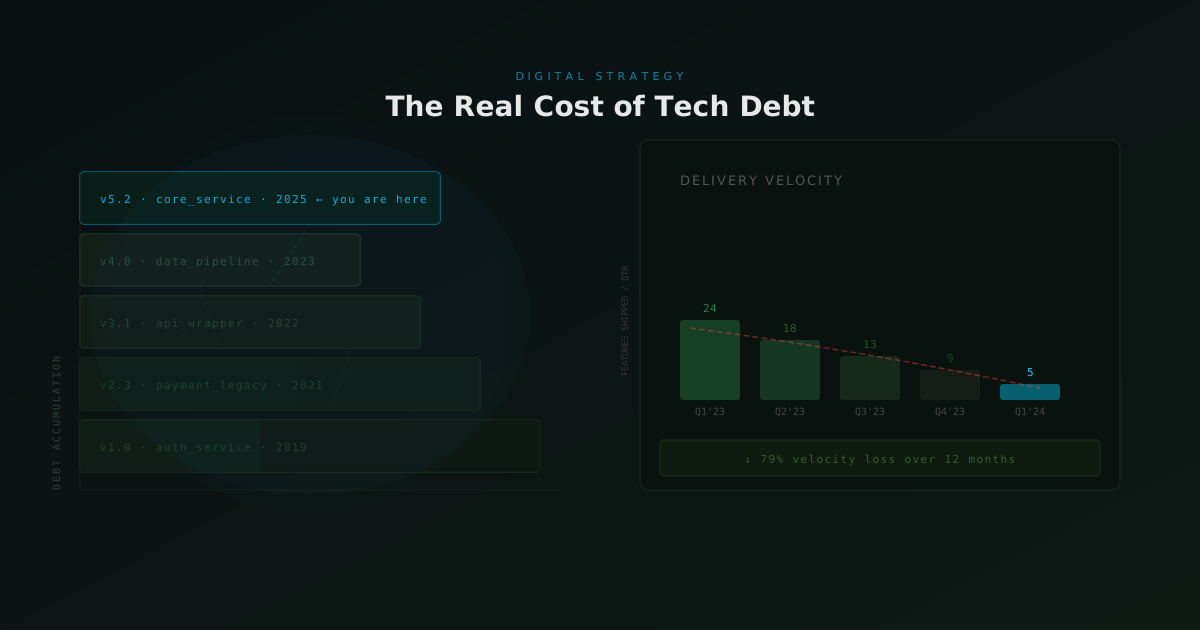
The most obvious cost is speed. Every new feature takes longer to build than it should. Every integration negotiation runs into "our system can't quite do that." Every sprint review has a version of "we hit an unexpected dependency." This isn't laziness — it's the tax on velocity that tech debt levies.
But there are less visible costs that matter just as much.
Talent cost. Good engineers don't want to work in codebases where they can't build anything cleanly. The highest performers leave first — they have the most options. What stays is often a team that's become normalised to the mess, which is its own kind of problem.
Strategic optionality cost. Tech debt constrains what you can do. An AI integration that would take six weeks in a clean system takes six months in a fragmented one. A market expansion that requires localising your platform becomes a 12-month project instead of a 4-month one. The debt doesn't just slow you down — it reduces what's possible.
Acquisition and fundraising cost. Technical due diligence is real. Sophisticated investors and acquirers run code reviews. A heavily indebted codebase raises questions about team quality, velocity, and what it will actually cost to scale. It affects valuation — sometimes significantly.
Why leadership often lets it accumulate
The standard story is that product pressure wins. "We'll refactor it after we ship this." And then the next thing ships. And the next. The refactor never comes because there's always something more urgent.
But there's a more fundamental issue: most leadership teams don't have a clear picture of where their debt is, how bad it is, or what it's actually costing them in delivery speed. Without that visibility, it's very hard to make a case for the investment to address it.
This is partly an engineering communication problem — technical complexity is hard to translate into business terms. But it's also a leadership accountability problem. If nobody owns the question of technical health at a strategic level, nobody fixes it.
What to do about it
You don't address tech debt by declaring a six-month moratorium on features and rewriting everything. That's usually slower, riskier, and more expensive than it sounds. The more practical approach:
Make it visible. Start with an honest audit. Not a detailed line-by-line review — a clear map of the highest-risk areas, what they're blocking, and what the estimated cost is in delivery time. Leadership needs to be able to see this clearly, not just hear a vague complaint about "legacy code."
Budget for it explicitly. A reasonable rule of thumb is allocating 20–30% of engineering capacity to debt reduction and platform health. Not as a vague aspiration — as a real protected budget that doesn't get cannibalised every time a product priority appears.
Prioritise by impact, not by severity. Not all debt is equal. The debt that blocks your next six product features is more important than the debt that makes a rarely-touched system slightly harder to maintain. Fix what's actually in the way.
Don't create more of it. The fastest way to accumulate tech debt is to keep making the same trade-offs without acknowledging their cost. Build in architectural review. Make the short-term/long-term trade-off explicit when it's being made, not when it's already embedded.
The leadership frame
Tech debt is a form of deferred risk. Like financial leverage, a small amount used strategically can be fine — even useful. A large amount that you've lost track of becomes a constraint on everything.
The leaders who manage it well aren't the ones who never take on any debt. They're the ones who take it on consciously, measure it, and invest regularly in reducing it. They treat technical health as a strategic asset — because at scale, it is.