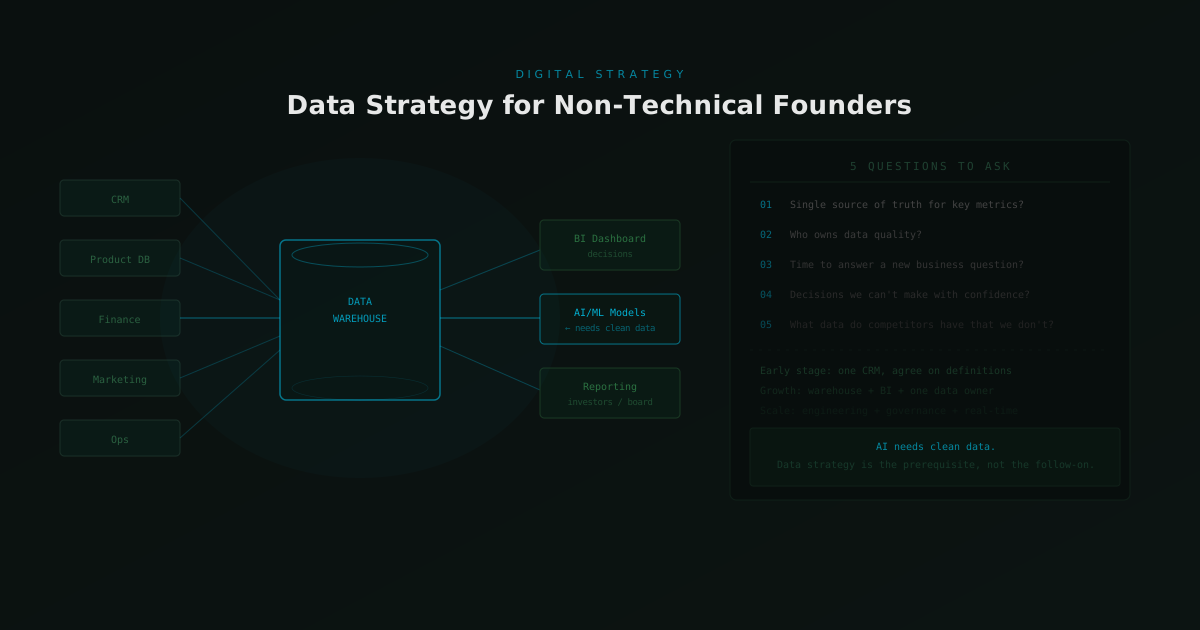
Data strategy is not a technology decision. It's a decision about what information you want to be able to act on, and what it takes to act on it reliably.
Most founders think about it too late. Usually when they hire their first data analyst and discover the data isn't in a shape that's useful. Or when they try to add AI to their business and find out the foundation isn't there to build on.
You don't need to understand the technology to make good decisions here. But you do need to ask the right questions early.
The five questions worth asking
These aren't technical questions. They're business questions:
- Do you have a single source of truth for your key metrics? Revenue, retention, conversion. If different people in the business are citing different numbers, you don't have a data strategy, you have a political problem with data as the symptom.
- Who owns data quality? Someone has to be accountable for the data being accurate. In early-stage companies, that's often nobody. The CRM is out of date, the analytics has gaps, the finance data doesn't reconcile with the product data.
- How long does it take to answer a new business question? If the answer is "two weeks and a spreadsheet," you're making decisions on stale information. At scale, that costs you.
- What decisions are you currently unable to make with confidence? Not "what data do we have" but "what are we missing that we actually need." This is the most useful frame.
- What data do your competitors have that you don't? Some data is a genuine competitive asset. Most companies don't think about this until it's too late to close the gap.
The stages of data maturity
Most growing businesses move through predictable stages. Knowing which stage you're at prevents you from building the wrong thing.
Early stage: you need one CRM, agreed metric definitions, and someone who checks that the numbers make sense. That's it. Don't overcomplicate this. A well-used spreadsheet beats an unused data warehouse.
Growth stage: once you have multiple systems, CRM, finance, product analytics, marketing, you need a centralised place where they all talk to each other. A data warehouse, a BI tool the leadership team actually uses, and one person who owns this. Not a team. One person.
Scale stage: this is where you get into real-time data, governance, data engineering as a discipline, and the infrastructure AI actually needs. Most early-stage founders try to skip to this. Don't.
The number of early-stage companies with sophisticated warehouse infrastructure but no agreed definition of "active user" is significant. They've invested in the pipes before knowing what they want to measure.
Where AI comes in
AI needs clean, well-structured, labelled data to produce reliable results. This is not a caveat, it's the main constraint.
The companies moving fastest with AI aren't necessarily the ones who moved fastest to adopt AI tools. They're the ones who built solid data foundations two or three years before the AI wave arrived. They had the infrastructure ready when the opportunity appeared.
If you're early in building your data foundations, don't think of it as "getting ready for AI." Think of it as making your business legible to itself as it grows. AI is the downstream benefit of work you should be doing anyway.
The one thing to do first
Define your three to five most important business metrics. Agree on exactly how each one is calculated. Make sure everyone in leadership is using the same definition.
Revenue: does that include refunds? Retention: 30-day or 90-day? Active user: any login, or actual engagement? These definitions feel trivial until you're in a board meeting and the CFO and CPO are quoting different numbers for the same thing.
Get alignment on the definitions before you worry about any of the tooling. Everything else in your data strategy is downstream of that.