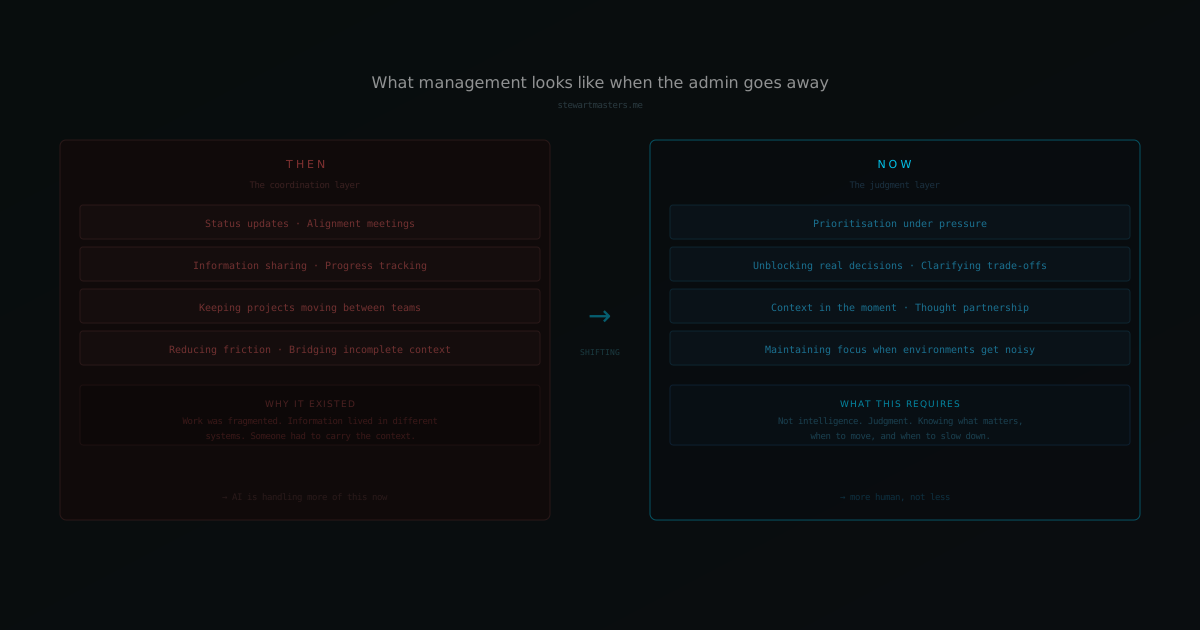
Something has shifted in my one-on-ones over the last eighteen months. Fewer status updates. Less time spent on "where are we with X" and more time on "what do we do about X." I assumed at first it was the team getting more autonomous. It wasn't. It was the coordination layer going away.
I've been thinking about what that means for management as a discipline. Not theoretically. In terms of what I actually do in a meeting now versus what I was doing two years ago, and whether the people I used to see as strong managers still look strong.
The coordination tax
For most of my career, a significant share of management was administrative. Not in a filing cabinet sense. In the sense that I was carrying context between people and systems. I knew where a project was because I had just come from the meeting where it was discussed. My reports knew what to prioritise next week partly because I had translated the quarterly objectives into something usable at team level. The information existed somewhere, but it didn't flow automatically. Someone had to move it.
That's what AI is starting to absorb. Summarisation, status aggregation, draft communication, meeting prep, notes that go anywhere. None of it is glamorous. All of it was real work. In a team of eight, a manager might spend four to six hours a week just carrying information from one place to another. That's a meaningful fraction of the working week, and it's one that most managers don't track because it never felt optional.
When it starts disappearing, the meeting schedule doesn't shrink. The agenda just fills with different things.
What's left when coordination goes
The first thing I noticed when the admin started clearing was that conversations got harder. Not worse. Harder. When you strip out the easy parts, what remains is the stuff that was always difficult and that everyone was quietly grateful to defer because the coordination work filled the time.
Prioritisation is the real problem. Not in a process sense. In the sense that five things matter and three of them conflict and someone has to decide which is actually more important. That has always been a manager's actual job, but coordination overhead meant you could spend an entire meeting talking about progress without having to make a real call. The informational work was cover.
Now that cover closes faster. The conversations that fill the gap are about judgment, not information.
What changes in one-on-ones
I've noticed a few things that shift once the admin goes away.
People bring different questions. Less "am I on track" and more "am I working on the right thing." That distinction matters more than it sounds. The first question needs a status check. The second needs a manager who can actually think about the work, not just receive an update about it.
The quality of the conversation depends more on the manager. When the conversation is informational, a mediocre manager still adds value. They process the update. They ask clarifying questions. The structure of the meeting carries them through. When the conversation is about judgment, there is nowhere to hide. Either you can think clearly about what matters, or you can't.
The best people notice the difference. Quickly. And they start to self-select toward managers who pass that test.
The paradox
Here is the part that surprises most people: removing the coordination layer does not make management less human. It makes it more.
The coordination work was mechanical. Necessary, but mechanical. What replaces it is the hardest part of any manager's job. Knowing what matters when everything feels urgent. Knowing when to push and when to slow down. Knowing how to hold a conversation that helps someone think more clearly without telling them what to think. Knowing when someone is one conversation away from burning out versus one conversation away from a breakthrough.
That is not AI territory. Not because AI cannot generate advice. Because the value of that kind of conversation comes from someone who knows you, knows the context, has skin in the game, and has earned the right to be honest with you. That is not a capability problem. It is a relationship problem. It requires presence and accountability in a way that no tool currently replicates.
What this asks of leaders
The practical implication is that the structural case for a management layer is weakening while the judgment case is strengthening. Managers who were primarily valuable because they kept information moving are in a difficult position. That value is being automated away, not incrementally but quite quickly.
Managers who are valuable because they can identify what matters, unblock real decisions, and operate well in ambiguity are becoming harder to replace. Not easier.
I don't think this means fewer managers in absolute terms. I think it means that the conversations they have need to be different ones. The question every manager should be sitting with is whether the value they create in a given week would survive the complete removal of administrative scaffolding. If the answer is no, that's worth taking seriously before someone else notices.
Most of the time, the answer will tell you exactly where to invest.