Evaluating a CTO is one of the hardest assessments a board or leadership team will make. The role is highly context-dependent, what works at 10 engineers doesn't work at 100, and most non-technical leaders don't have the reference points to distinguish genuine technical capability from confident-sounding performance. The result is that CTO assessments are often either too superficial or delegated entirely to technical advisors who assess technical depth without enough weight on leadership and business alignment.
Why this is harder than it looks
The CTO role at growth-stage companies is genuinely one of the most demanding leadership positions in the organisation. It requires deep technical credibility, enough to earn respect from the engineering team and make good architecture decisions, combined with real business acumen, the ability to manage upward and across functions, and strong people leadership. Very few people are great at all of these.
The additional complication is that the right CTO at one stage of a company's growth is often the wrong CTO at the next. A founder-engineer who built the product from scratch may have none of the management, communication, or strategic skills needed to lead a 50-person engineering organisation. This doesn't mean they've done anything wrong. It means the job has changed.
The four archetypes
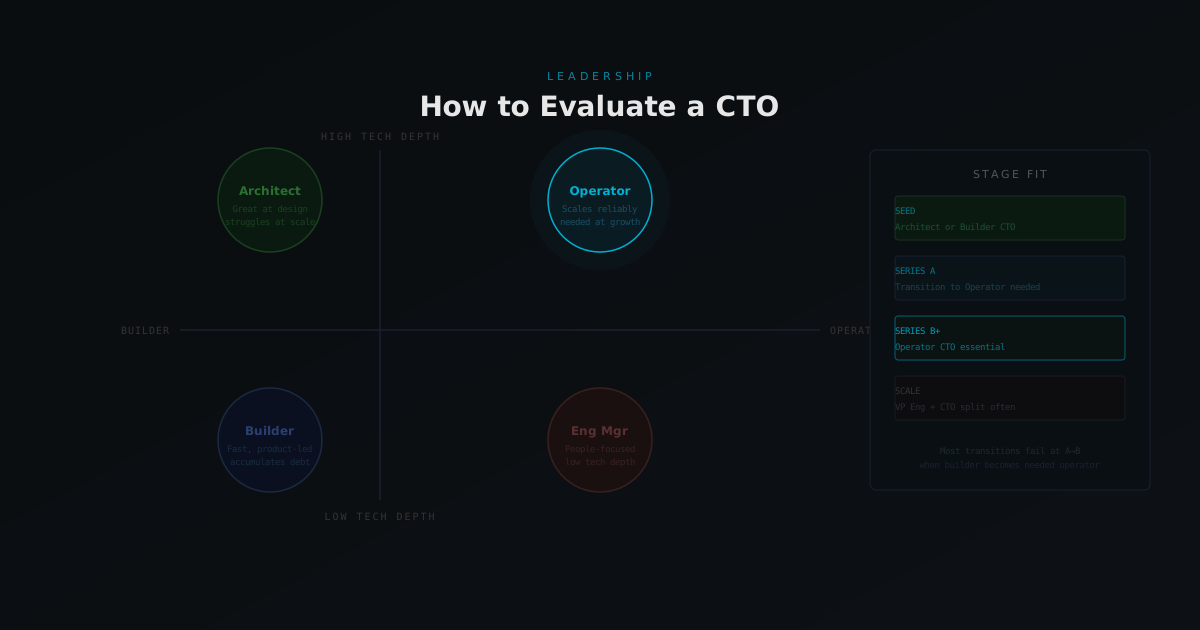
It's useful to think about CTOs across two dimensions: technical depth versus leadership breadth, and builder orientation versus operator orientation. Most CTOs skew heavily toward one of four patterns:
- The Architect: Deep technical, loves systems design, less comfortable with people management. Excellent at early-stage technical decisions, can struggle as the team grows.
- The Engineering Manager: Primarily a people leader who happens to have a technical background. Good at building teams, may not have the technical depth to challenge architects or make hard platform choices.
- The Builder: Product-oriented, fast-moving, strong on delivery. Best at pace-over-elegance environments; can leave technical debt that becomes expensive later.
- The Operator: Systems thinker, strong on process and reliability. Best at scaling existing capabilities; may not be the best at 0-to-1 product development.
Understanding which archetype your current CTO fits, and which archetype the business actually needs now, is the starting point for an honest evaluation.
What builder CTOs get wrong at scale
The most common CTO transition issue occurs when a founder-engineer CTO reaches the limit of their leadership capability rather than their technical capability. They're excellent engineers. They may be brilliant technical thinkers. But they've never had to manage managers, never had to communicate technical trade-offs to a board, and never had to make decisions about architecture they didn't personally design.
The signs are recognisable: the team grows but the CTO remains personally involved in too many individual technical decisions. Reporting lines are unclear because the CTO hasn't built a real management layer. The engineering team is strong technically but underperforms on delivery, because nobody has built the operational cadence that makes teams ship reliably.
The questions that reveal most
In evaluating a CTO, these questions tend to be the most diagnostic:
- How has your approach to running the engineering team changed in the last 12 months?
- What's the biggest technology risk in the business right now, and what's your plan to address it?
- How do you decide what the team works on? Walk me through your last planning cycle.
- What's the biggest technical mistake you've made in this role, and what did you do about it?
- When did you last push back on a product or business request? What happened?
A CTO who can answer these questions with specificity, honesty, and self-awareness is almost certainly in control of the function. Vague answers, excessive confidence without evidence, or an inability to name a real mistake are warning signs.
Red flags in how CTOs communicate
How a CTO communicates about technology tells you a great deal about their leadership capability. Watch for: jargon-heavy presentations to non-technical audiences (inability to translate), relentless optimism about delivery timelines (lack of honest assessment), blame attribution to product or business for engineering problems (accountability gaps), and an inability to explain trade-offs clearly (possible lack of strategic thinking).
The best CTOs are translators. They can be precise and technical with engineers, and equally clear and direct with non-technical leadership. They're not performing for either audience, they're genuinely bilingual.
Making the decision
If the evaluation reveals that the current CTO is not right for the stage the business is at, there are several paths: a defined transition to a more appropriate role (Head of Architecture, Principal Engineer), a structured development plan with clear milestones and support, or, in some cases, a change. The latter is always painful and should not be the first option. But a business that keeps a CTO in role beyond their capability ceiling pays a tax in slow delivery, technical debt, and talent loss that accumulates quickly.
The most important principle is to evaluate honestly and early. CTOs who are in the wrong role usually know it, they're often relieved to have an honest conversation about it. The organisations that handle this well are those that create the conditions for that conversation to happen.