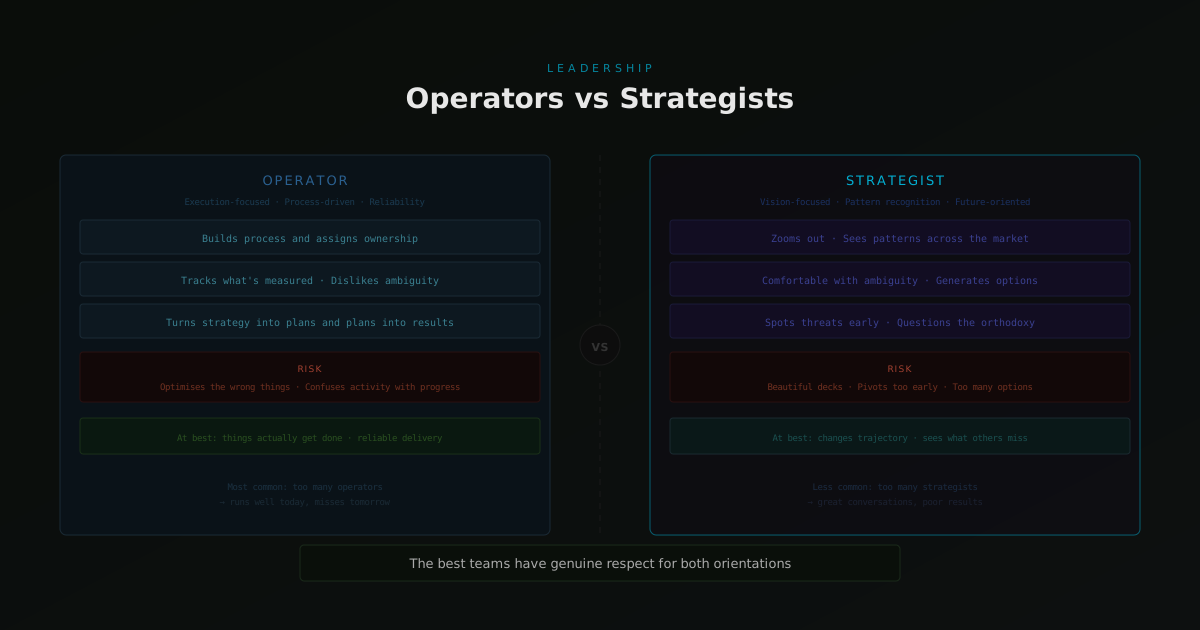
Every leadership team has a personality. And most of the time, that personality is determined less by intention than by the hiring patterns of the founder or CEO. If the CEO is an operator, methodical, process-driven, deeply attuned to execution, they tend to surround themselves with other operators. If the CEO is a strategist, visionary, pattern-seeking, drawn to the next big idea, the team tends to reflect that too.
Both types are essential. Neither type, alone, builds a great business at scale. Understanding which you have, and what's missing, is one of the most useful diagnostic tools a leader can have.
What operators actually do
Operators run things. Their instinct, when confronted with a problem, is to build a process, assign ownership, and create accountability structures. They care about reliability. They track what's measured. They get uncomfortable when things are undefined or when decisions aren't being made.
At their best, operators are the reason anything actually gets done. They turn strategy into plans, plans into tasks, and tasks into shipped products and served customers. They build the systems that let a business run at scale without being personally involved in every decision.
At their worst, operators optimise the wrong things. They can become so focused on process efficiency that they miss the fact that the process itself needs to change. They can confuse busyness with progress and activity with results. A team of operators without strategic challenge will execute its way into a position that no longer makes sense.
What strategists actually do
Strategists see patterns. Their instinct, when confronted with a problem, is to zoom out to understand where this fits in a broader picture, what it means for the next few years, how the market is moving. They're comfortable with ambiguity. They generate options. They get restless with anything that feels like incremental improvement when the whole approach needs rethinking.
At their best, strategists change the trajectory of a business. They identify adjacencies that operators miss. They see threats early and position for opportunities before the market has priced them in. They ask the questions that make execution teams uncomfortable in useful ways.
At their worst, strategists produce beautiful decks and frustrating delivery. They pivot before the last idea has been properly tested. They generate so many options that nothing gets decided. A team of strategists without operational discipline generates great conversations and poor results.
The imbalances that are most common
In my experience, the most common imbalance in scaling businesses is too many operators, not enough strategic challenge. This is especially true in businesses that grew through operational excellence, restaurants, retail, logistics, hospitality. The culture rewards execution. The senior team got promoted because they executed. Strategy feels like a distraction from the real work.
The result is a business that runs well today and misses the shifts that will determine whether it runs at all in five years. AI adoption in operationally excellent businesses often fails for exactly this reason, the operators can see that today's process works fine, and the case for disrupting it is a strategic argument that nobody on the team is built to make.
The less common but more visible imbalance is too many strategists, not enough operational spine. This is more common in VC-backed startups with visionary founders. The business has a compelling story, a clear whitespace, and a leadership team that can articulate the opportunity in every possible dimension. And it consistently fails to execute. Things don't ship on time. The product roadmap changes every quarter. The ops metrics tell a different story than the investor narrative.
How to read your own team
Some useful diagnostic questions:
- When a big problem surfaces in a leadership meeting, what happens? Does the team immediately move to process and ownership, or to broader context and implications?
- How often does the team challenge its own strategy, genuinely, not just performatively?
- What kind of hires does the team default to when they need to add capacity?
- Who in the team is most uncomfortable? Operators are uncomfortable when there's ambiguity; strategists are uncomfortable when everything feels too settled.
The team's discomfort profile tells you a lot. A team where everyone is uncomfortable with ambiguity is a team of operators. A team where nobody is uncomfortable with ambiguity probably isn't tracking the right things.
Building in the missing element
Once you've identified the imbalance, there are a few ways to address it. Hiring is the obvious one if you need more strategic challenge, hire for it deliberately. Fractional or advisory talent can be useful here, particularly if the culture makes it hard to absorb a full-time strategic hire who will challenge the orthodoxies the team has built.
But it's also worth noting that most people are capable of more range than their role requires of them. Operators who are given genuine responsibility for competitive positioning often develop more strategic instinct than you'd expect. Strategists who are required to run something to own the delivery, not just the vision, often become more operationally grounded.
The leadership teams that work best aren't perfectly balanced in some theoretical sense. They're teams where the different orientations have genuine respect for each other, where the operator doesn't dismiss strategy as "just talking" and the strategist doesn't dismiss operations as "just managing." That mutual respect is what makes a team capable of both thinking well and executing well.