I have sat through board meetings where an hour was spent discussing whether a particular phrase in last quarter's minutes was accurate. I have sat through board meetings where a significant capital allocation decision was reached in eight minutes, without the full board having read the supporting paper. Both of these are board failures. The first is a failure of time management. The second is a failure of governance. Both are common. Neither is inevitable.
The board meeting is the highest-value meeting in any organisation. It has the most experienced people in the room, the most significant decisions on the agenda, and the least time to make them. Used well, it makes the business faster and better. Used badly, it demoralises the executive team, produces bad decisions, and consumes preparation time that could have been spent operating.
What most board meetings get wrong
The most common failure mode in board meetings is that they are designed to inform rather than to decide. The management team presents what happened last quarter. The board asks questions. Everyone goes away having been updated. This is not a board meeting, it's a briefing. A briefing is useful, but it doesn't require a board.
A board meeting should be designed around decisions: what does the board need to decide in this meeting, and what information does it need to decide well? Everything else, the historical performance, the market context, the operational update, is supporting material. It belongs in the board pack, read before the meeting, not in the meeting itself.
The second failure mode is that the agenda is structured by function rather than by decision. "Finance report, Operations report, HR update, AOB" is a functional agenda. It ensures that every function has airtime and guarantees that the meeting never gets to the things that actually matter. A decision-based agenda looks different: "Decision: capital allocation for the Manchester expansion. Decision: renewal of the technology partnership. Discussion: strategic response to competitor pricing change. Update: read in pack."
If you can't name the three decisions this meeting needs to make, you don't have an agenda. You have a schedule.
The structure that works
The board meetings I've seen work best follow a consistent structure:
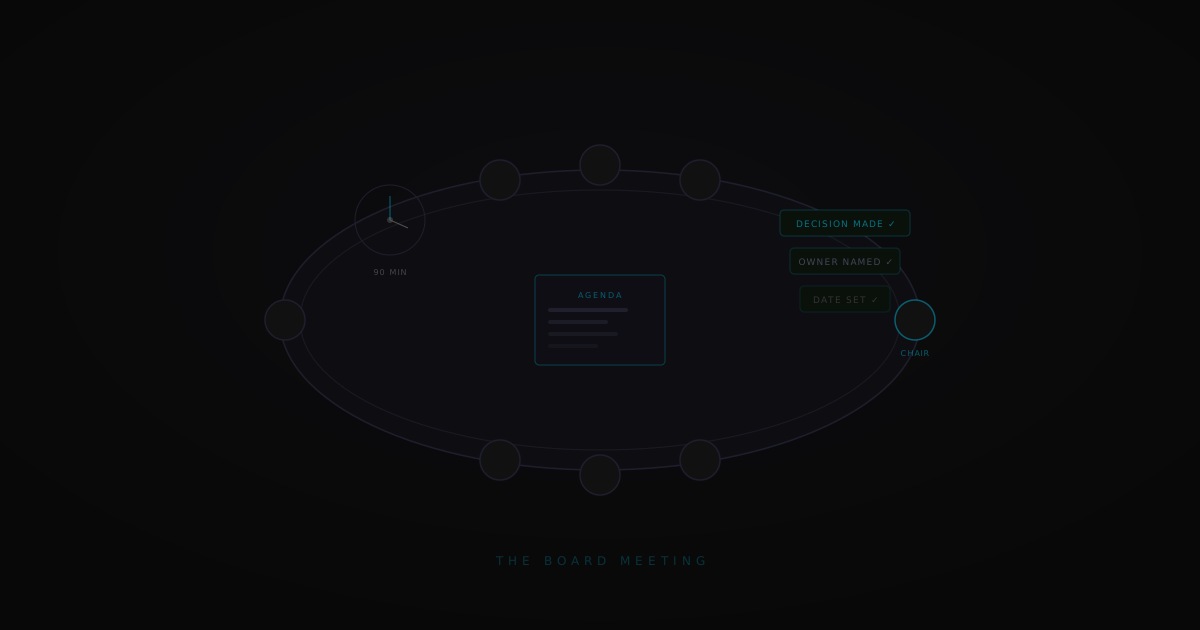
Pre-reading, not pre-briefing. The board pack goes out five days before the meeting. It contains the full context for every decision on the agenda, the management's recommendation, and the key risks and alternatives. Board members read it. If they haven't, the meeting can't function. The chair has to hold this standard.
Consent agenda for routine items. Minutes from the last meeting, standard governance approvals, routine finance sign-offs, these go into a consent agenda that is approved as a block at the start of the meeting unless a board member flags a specific item for discussion. This recovers 30–40 minutes that would otherwise be spent on things that don't require collective discussion.
Decision items first, while energy is high. The most important decisions go at the top of the agenda, before the operational updates, before the committee reports, before AOB. The board should be at its most alert when the most consequential decisions are being made.
Discussion items have a clear frame. When a topic is on the agenda for discussion rather than decision, the chair should say so explicitly at the start: "We're not here to decide today. We're here to explore the options before the decision at the next meeting." Without this framing, discussions drift toward premature decisions, or toward endless deferral.
Actions are explicit and named. Every meeting ends with a read-back of decisions made and actions assigned. Not "the management team will look at the pricing issue" — "the CFO will provide a recommendation on the pricing change by March 20th." Vague actions are no actions.
What the chair's job actually is
The chair's job in a board meeting is not to manage the agenda. It's to manage the quality of the decisions. That means intervening when a discussion is going in circles, calling a vote when there's a clear disagreement that isn't resolving through discussion, protecting quieter board members from being talked over, and knowing when a decision isn't ready and needs more information rather than a forced vote.
It also means knowing when to stop a management presentation that has gone off track. A board meeting is not a stage for the management team to demonstrate how hard they've been working. It's a decision-making forum. The management team's job is to give the board what it needs to decide, not to impress it with comprehensiveness.
The best board chairs I've worked with do something counterintuitive: they spend less time talking than any other person in the room. They ask the questions that nobody else will ask. They close discussions that aren't moving. They focus the room on what needs to be decided. That is a skill, and it is the most valuable skill in the room.