The restaurant industry sits in an interesting position with AI. On one hand, it operates on thin margins with high complexity, exactly the conditions where operational improvements have the most leverage. On the other, the core product is a human experience, which means misapplying technology damages the thing you're selling.
Having worked inside a fast-growing restaurant group navigating these decisions, I've seen what the vendor pitches promise, what the pilots actually deliver, and where the real value tends to end up. The gap between the three is significant.
Where AI is delivering real value
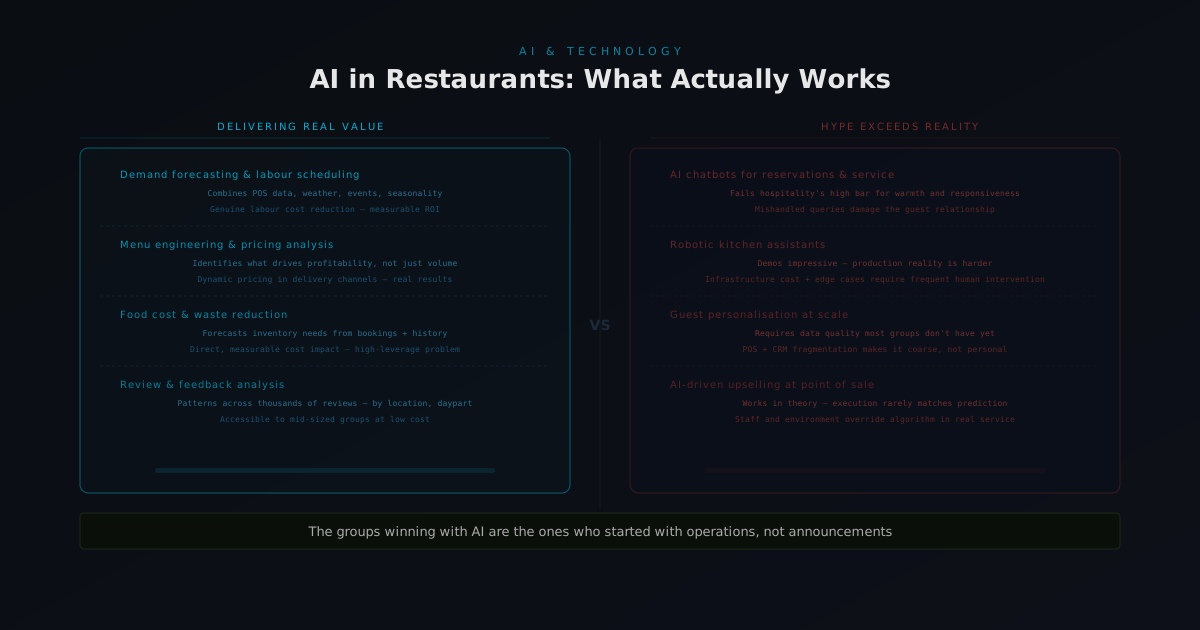
Demand forecasting and labour scheduling. This is probably the highest-impact application in the industry right now. AI-driven forecasting that combines historical sales data, weather, local events, and seasonality can predict covers and revenue with considerably more accuracy than rule-of-thumb scheduling. When that feeds directly into labour scheduling, the efficiency gains are genuine, typically a few percentage points off labour cost, which at restaurant margins is significant.
The prerequisite is clean historical data going back at least two years, integrated POS data, and some mechanism to input local event data. Groups with fragmented systems or inconsistent data collection don't see the same results. The technology works; the data readiness is the actual constraint.
Menu engineering and pricing analysis. Combining sales data with margin data to identify which items are actually driving profitability, rather than volume, is well-suited to AI analysis. Pattern recognition across items, dayparts, seasons, and customer segments surfaces insights that would take weeks to derive manually. AI doesn't replace the chef's judgment about what belongs on the menu, but it provides much better information to support that judgment.
Dynamic pricing, adjusting prices based on demand signals, is an extension of this that's generating real results in delivery channels, where the friction of changing prices is lower and customer expectations are different.
Food cost and waste reduction. AI-driven inventory management that predicts what you'll need based on bookings, historical patterns, and order trends reduces both over-ordering (waste) and under-ordering (86'd items, disappointed guests). The ROI here is direct and measurable. Waste is one of the highest-cost problems in restaurant operations and one where better forecasting has immediate impact.
Review and feedback analysis. Processing thousands of guest reviews to identify specific, actionable patterns, not just sentiment scores, but precise operational issues by location, daypart, or menu item, is something AI does well and that previously required either a large analytics team or an expensive third-party service. This is accessible now to mid-sized groups at relatively low cost.
Where the hype exceeds the reality
AI-powered chatbots for reservations and customer service. The promise is 24/7 guest communication without staff. The reality is that guests in hospitality have high expectations for responsiveness and warmth, and current AI chatbots fail those expectations often enough to create problems rather than solve them. Mishandled reservation queries and frustrating loops are worse for the relationship than a delayed human response.
The narrow use case where chatbots work is high-volume, low-stakes queries — "what are your opening hours?", where the downside of a poor interaction is low. For anything involving a guest experience decision, human involvement still produces better outcomes.
Robotic kitchen assistants. The vendor demonstrations are impressive. The reality in production environments is that kitchen equipment designed for AI-assisted cooking requires infrastructure investment, maintenance overhead, and staff retraining that most restaurant groups are not positioned to absorb. The edge cases, ingredient variations, recipe adjustments, equipment failures, require human intervention with a frequency that undermines the automation value. This is a technology that will matter in five to ten years. It's not where the operational wins are today.
Personalisation at scale. The idea of personalising guest communications, menus, and offers based on historical behaviour is attractive. In practice, most restaurant businesses don't have the data quality or the integrated tech stack to execute it at meaningful scale. Loyalty programme data is often incomplete. POS and CRM systems don't talk to each other. The personalisation that emerges from this infrastructure is usually too coarse to feel personal and too complex to maintain. This is a real opportunity for groups that have invested in data infrastructure; it's not accessible to most.
The implementation questions that matter most
For any AI investment in a restaurant context, there are four questions worth answering before committing:
- Is the data that this system needs clean, accessible, and consistently maintained? If not, fix the data problem first.
- Who in the operations team owns the output? If there's no named person whose job it is to act on the AI's recommendations, the system will produce insights that nobody uses.
- What happens when the system is wrong? AI forecasting is not perfect. Scheduling systems will sometimes get it wrong. The process for overriding AI recommendations when the on-the-ground situation is different matters enormously.
- How does this fit into how people actually work? If using the AI output requires extra steps, switching between systems, or manual translation into other tools, adoption will be low regardless of how good the technology is.
The honest assessment
Restaurant AI has a useful set of well-established use cases, forecasting, scheduling, cost management, feedback analysis, and a longer list of emerging applications that are real but not production-ready for most operators. The mistake is chasing the emerging applications at the expense of the proven ones.
The groups doing this well are the ones who started with the operational pain points, identified where data-driven decision-making could replace intuition and spreadsheet-based analysis, and built incrementally. They're not the ones who announced an AI strategy. They're the ones who quietly reduced food cost by two points and improved labour efficiency without a press release.