Hospitality has always been a people-first industry. Digital transformation in hospitality isn't changing that. What it's changing is where people spend their time, and what they're freed from doing.
The conversation about technology in hospitality still tends to focus on the visible: check-in kiosks, mobile keys, ordering apps. These get photographed and featured in trade press. The more significant transformation is happening in the operational layer in the systems that determine what staff see, what decisions get made automatically, and how quickly problems surface and get resolved.
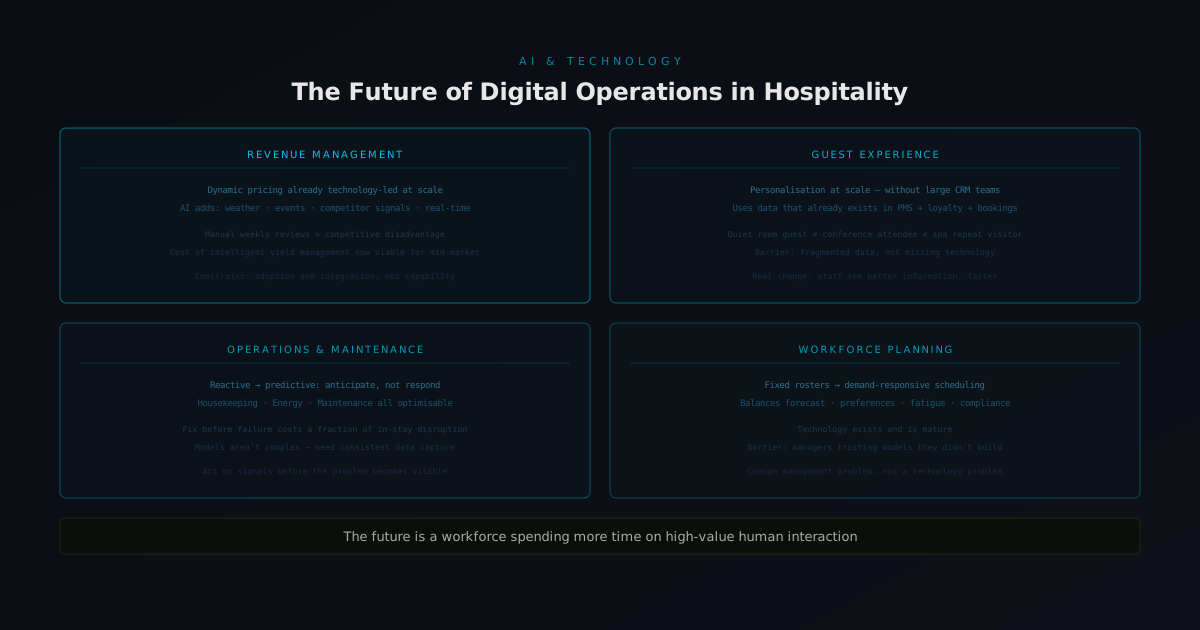
Yield management, dynamic pricing, and demand forecasting have been technology-led for years in larger properties. AI is accelerating that shift, incorporating signals from weather data, local events, competitor pricing, and booking pattern analysis in near real-time.
The operators still relying on manual revenue managers doing weekly spreadsheet reviews are competing at a disadvantage. The technology cost of intelligent yield management has dropped to the point where it's viable for mid-market properties. The constraint is now adoption and integration, not capability or price.
Not through impersonal automation, but through smarter use of the data that already exists. A guest who has stayed three times, always requested a quiet room, and never visited the spa receives different communications, and a different in-stay experience, than one who attended two conferences and upgraded to a suite each time.
The barrier isn't technology. Most properties already have enough data in their PMS, loyalty systems, and booking history to do this meaningfully. The barrier is fragmented data infrastructure and the operational willingness to act on it consistently.
Maintenance scheduling, housekeeping prioritisation, energy management, these are shifting from calendar-based or complaint-driven approaches to predictive models that anticipate demand and optimise accordingly.
Predictive maintenance alone has meaningful cost implications. Replacing a component before it fails costs a fraction of the labour, disruption, and guest recovery associated with an in-stay failure. The models aren't complex, they require consistent data capture and the discipline to act on signals before the problem is visible.
Fixed rosters built two weeks in advance are being replaced, slowly by demand-responsive scheduling that balances business forecast, staff preferences, fatigue management, and regulatory requirements simultaneously.
The technology for this exists and is mature. The adoption challenge is getting operations managers to trust a model they didn't build, and getting HR teams to redesign rostering processes that have been unchanged for a decade. This is a change management problem more than a technology problem.
The future of hospitality operations isn't a lobby full of kiosks. It's a workforce that spends more time on high-value human interaction because low-value manual processes have been automated, and a business that has better information, earlier, to make better decisions.
The organisations getting there fastest are the ones treating digital transformation as an operational discipline rather than a technology project. They start with the problem, where is friction destroying the guest or staff experience?, and work backwards to the solution. The technology choices follow from that, not the other way around.