Agentic AI is appearing in almost every enterprise AI conversation at the moment. It's also one of the least clearly defined concepts in that conversation. Most people using the term mean something slightly different. Getting clarity on what it actually is, and what it isn't, is useful before committing resources to it.
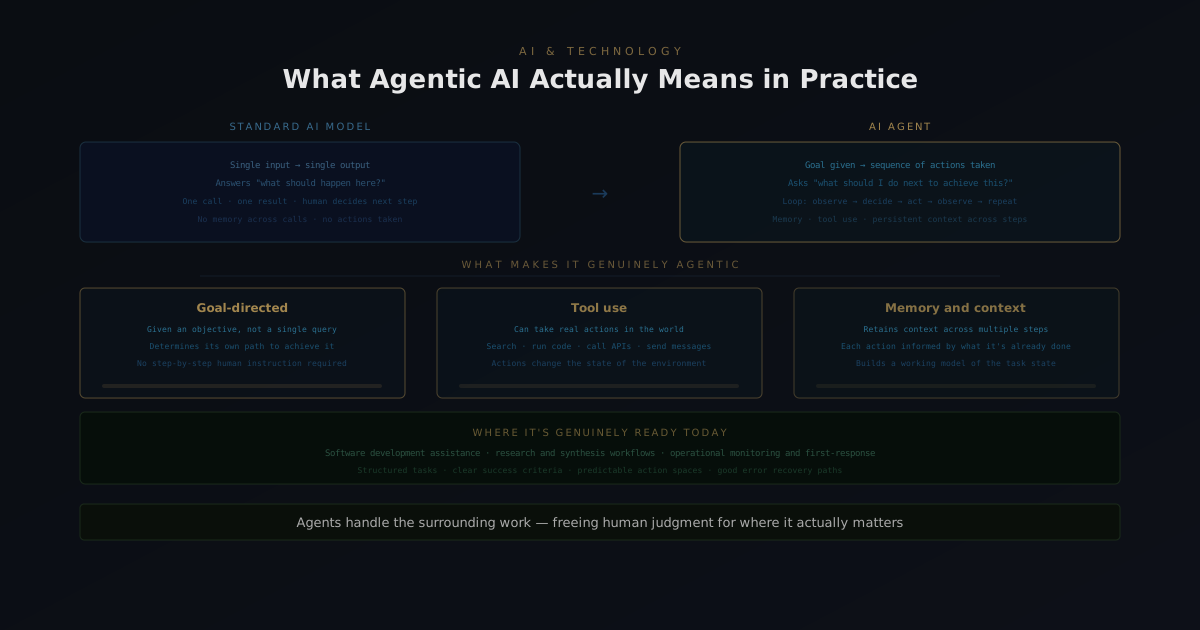
An AI agent is a system that pursues a goal by taking a sequence of actions, using the results of each action to inform the next. Rather than receiving a single input and producing a single output, an agent operates in a loop: observe the current state, decide on an action, take the action, observe the result, repeat. The agent continues until it achieves its goal or determines that it can't.
The practical difference from a standard AI model: a standard model answers "what should happen here?" An agent asks "what should I do next to make the desired outcome happen?" and then does it, repeatedly, without a human directing each step.
Three characteristics define genuinely agentic behaviour:
Many systems marketed as "agentic" have some of these characteristics but not all. A chatbot that calls a search API is not an agent in any meaningful sense. A system that can break a complex task into subtasks, execute each one, evaluate the results, and revise its approach based on what it finds, that's genuinely agentic.
The operational significance of agentic AI is that it changes the unit of work that AI can handle. Previously, AI could support a decision or generate a piece of content. An agent can execute a workflow, not just support the human making decisions within it, but carry out the sequence of actions required to complete it.
This is a meaningful shift in capability. Consider tasks like: researching a supplier and producing a due diligence summary, monitoring a set of web sources and flagging changes relevant to a specific business question, or handling the first-line response to a customer query by gathering context from multiple internal systems before escalating. Each of these is multi-step, requires judgment at multiple points, and involves accessing multiple tools or data sources. Each is within range of current agentic AI systems.
Agentic AI introduces a governance challenge that single-output models don't have: the agent is taking actions with real consequences, and those actions may not be immediately visible to the humans nominally overseeing the process. An agent that sends emails, modifies records, or places orders is doing things in the world, not just making suggestions.
The practical response to this is designing clear boundaries around what actions an agent is authorised to take without human review, what conditions require escalation, and how the agent's actions are logged and auditable. These are not optional features, they're the governance layer that makes agentic deployment responsible.
The honest assessment of agentic AI maturity in 2026: it's reliable for structured tasks with clear success criteria, predictable action spaces, and good error recovery paths. It's less reliable for ambiguous tasks, high-stakes decisions, or situations where mistakes are hard to reverse.
The most successful enterprise deployments of agentic AI are currently in areas like: software development assistance (agents that can read code, write tests, run them, and fix failures autonomously), research and synthesis workflows (agents that gather and summarise information from multiple sources), and operational monitoring (agents that watch for specific conditions and take defined first-response actions). These are areas with enough structure for agents to operate reliably while keeping humans in appropriate oversight roles.
The genuine value isn't in replacing human judgment, it's in handling the surrounding work that currently consumes time that could be better spent on judgment. That's the practical case for agentic AI, and it's a strong one.