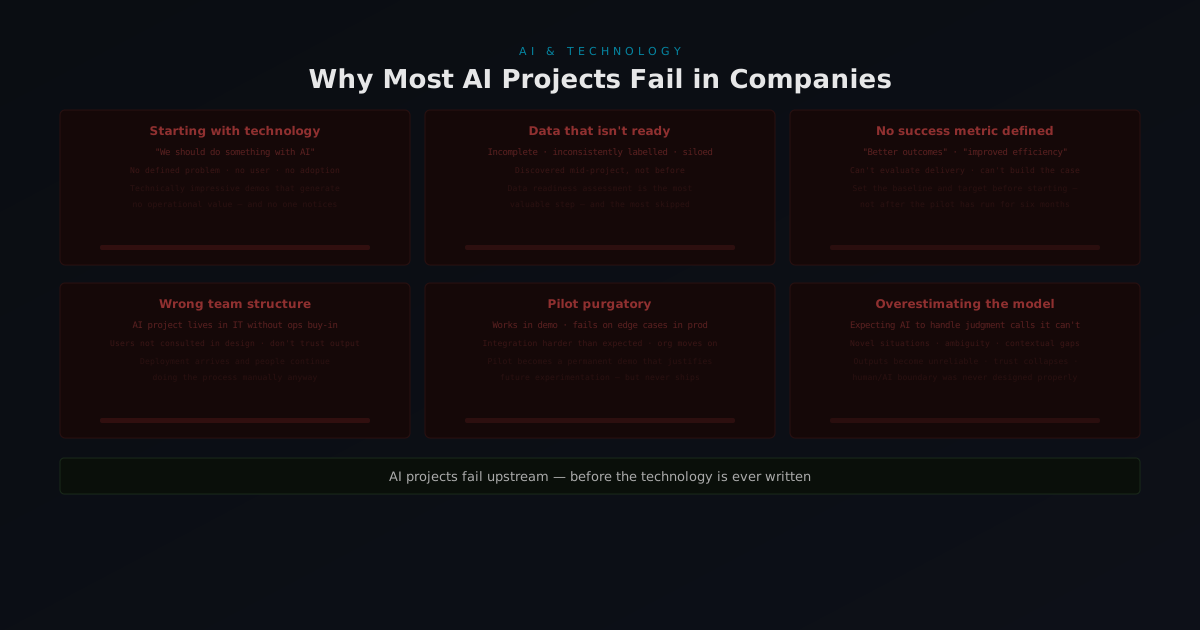
The failure rate for enterprise AI projects is genuinely high. Industry research consistently puts it above 70%. The striking thing is that most of these projects fail for reasons that have nothing to do with whether the technology works — the models, infrastructure, and tooling are generally capable enough. The failures are almost always upstream.
The most common failure mode starts with the framing: "we should do something with AI" rather than "here's a specific problem worth solving." When the mandate is to implement AI, teams build something. It may be technically interesting, even impressive in a demo. But without a genuine operational problem driving it, there's no user, no adoption, and no value.
Every AI project worth doing starts with a problem definition: what decision is currently being made badly, slowly, or inconsistently, and what would change if it were made better? If you can't answer that clearly before you start, the project is already in trouble.
AI systems are only as good as the data they're trained or fine-tuned on. Most organisations discover mid-project that their data is incomplete, inconsistently labelled, siloed across systems, or in formats that require substantial cleaning before they're usable. This isn't a new problem — it predates AI — but AI projects surface it with particular urgency because the dependency is hard to work around.
A data readiness assessment before committing to an AI project is not optional. It's the single most valuable thing you can do before any significant investment. If the data isn't there, address that first.
What does success look like? If the answer is "better outcomes" or "improved efficiency" without specific, measurable definition, you can't evaluate whether the project has delivered. This matters for two reasons: you can't know when to stop iterating, and you can't build the case for continued investment.
Good AI projects define their success metrics before they start: what is the baseline, what is the target, how will it be measured, and over what timeframe. This is not bureaucracy — it's the discipline that separates projects that deliver from projects that drift.
AI projects that sit entirely in IT or in a centralised "digital team" without operational buy-in fail at deployment. The people who will actually use the output of the system are often not involved in designing it. When deployment arrives, they haven't been consulted, they don't trust the output, and they continue doing the process manually.
The team structure that works has operational stakeholders involved from the start — not as sponsors who review quarterly updates, but as active participants in defining what the system needs to do and validating whether it does it.
Many AI initiatives produce a working pilot that never becomes a production system. The pilot works in controlled conditions but falls short on edge cases. Integration with production systems is more complex than anticipated. The organisation moves on to the next priority. The pilot lives on as a demo that justifies continued experimentation but never generates operational value.
The path out of pilot purgatory requires treating production deployment as the goal from the start, not as a later phase. The technical architecture, the operational integration plan, and the change management work all need to be scoped before the pilot begins, not after it succeeds.
AI systems are good at pattern recognition in well-defined domains with sufficient training data. They are not good at judgment in novel situations, at navigating ambiguity without structure, or at making decisions that require contextual understanding beyond what's encoded in the training data. When AI is deployed in contexts that require these capabilities, the outputs are unreliable and the people using them quickly lose confidence.
The most successful AI implementations are deliberate about the boundary between what the AI handles and what humans handle. That boundary is a design decision, and getting it wrong — in either direction — is one of the most common and costly mistakes in enterprise AI.