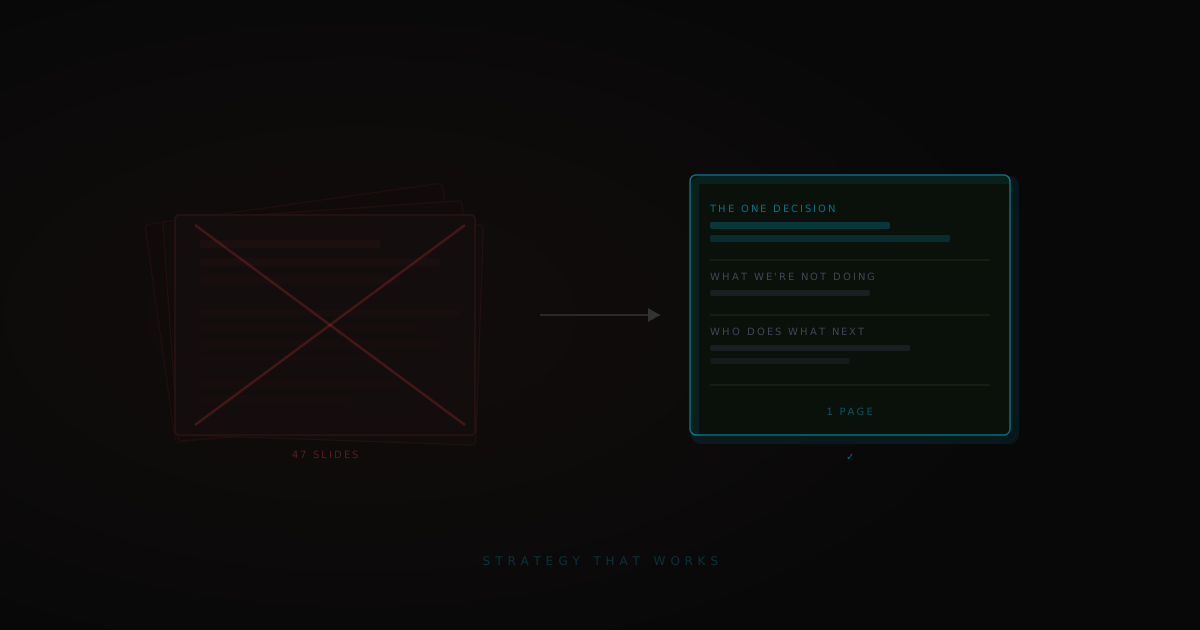
In twenty years of working across businesses at every stage and in every sector, I have sat through an extraordinary number of strategy presentations. I have seen strategy decks that ran to 140 slides. I have seen strategy documents that were genuinely excellent. And I have seen every failure mode in between.
The bad ones tend to fail in the same ways. Once you've seen the pattern enough times, you start recognising the symptoms before you've finished the first slide.
The four sins of bad strategy
Too much market analysis. This is the most common failure mode. The deck opens with 20 slides about market size, competitive landscape, customer personas, and trend analysis. All of it is accurate. None of it is strategy. Strategy is not describing the situation you're in. Strategy is deciding what you're going to do about it. A deck that spends half its slides on analysis and three slides on "direction" has the ratio exactly backwards. The team has confused the work of understanding the problem with the work of solving it.
Solutions presented as strategy. "We're going to launch a loyalty programme." "We're going to invest in AI." "We're going to expand into the German market." These are tactics dressed up as strategy. Strategy is the reason you're doing the thing, not the thing itself. A loyalty programme is a solution. The strategy is the belief that retention is the highest-value lever in your growth model, and here's the evidence for why. Without the reasoning, the solution is just a guess with better formatting.
Too many priorities. Most strategy decks I've seen list between five and nine strategic priorities. This is not strategy — it's a list of things the business was going to do anyway, repackaged with a consistent visual theme. Real strategy requires choice. Specifically, it requires the choice not to do things that seem important. A strategy with eight priorities has the same problem as a strategy with no priorities: there's no guidance for what to do when two things conflict. And in a real business, things conflict constantly.
False certainty. The deck presents three-year financial projections with two decimal places. It presents market share targets that assume a specific competitive response. It presents a timeline that has no slack, no risk assessment, and no version of events in which things don't go exactly as planned. Real strategy is an informed bet, not a guarantee. The best strategies I've seen are explicit about what they're betting on, what would have to be true for it to work, and what would cause them to change their mind. False certainty doesn't inspire confidence — it destroys credibility when the first assumption turns out to be wrong.
A strategy that can't be held in one person's head cannot be executed by a hundred people in the field.
What good strategy actually looks like
Good strategy has three properties that bad strategy almost never has:
One decision that changes everything. Every strategy worth the name contains one core bet — a single belief about how the world works that, if true, makes everything else follow. Not "we believe in customer centricity" — that's a value, not a bet. "We believe that the market will consolidate around fewer, better-quality players in the next three years, and the business that builds the deepest operational infrastructure now will be impossible to compete with at scale" — that's a bet. It can be right or wrong. It can be tested. It shapes every resource allocation decision that follows.
Honest about what you're not doing. The explicit not-doing list is the most underrated section in any strategy document. It says: we have considered these things. We have decided not to do them, for the following reasons. This protects the strategy from being diluted by the next shiny idea, and it protects the team from having to relitigate every decision every time a new opportunity appears. A strategy without a not-doing list is not a strategy — it's an aspiration, and aspirations bend under pressure.
Short enough to hold in your head. If the people executing the strategy can't remember what the strategy is, the strategy doesn't exist for them. The board deck is not the strategy. The 80-slide presentation is not the strategy. The strategy is whatever the floor manager, the product manager, and the regional director can articulate without looking anything up. If your strategy requires a reference document, it's too complicated. Simplify it until you can explain it in three sentences — and then ask yourself whether the three sentences are actually guiding decisions, or just describing a direction.
Why we keep producing bad strategy
The most honest explanation for why bad strategy is so common is that good strategy is uncomfortable to write. It requires saying no to things that seem important. It requires admitting uncertainty. It requires making a bet and being specific enough that you can be proven wrong.
Bad strategy is comfortable because it includes everything. Nobody can object to a priority that's listed in the deck. Nobody can criticise an analysis section that's comprehensive and well-researched. Nobody can disagree with a financial model that was built by a good analyst. The process of building a bad strategy deck produces consensus through exhaustion — everyone sees their concern addressed, everyone sees their priority mentioned, and nobody has to feel like they lost.
Good strategy produces a different kind of discomfort. Someone's priority didn't make the cut. Someone's market didn't make it into the plan. Someone's idea got put explicitly in the not-doing list. This is what alignment actually feels like when it's real — not comfortable agreement, but acknowledged disagreement that's been resolved in a specific direction.
The test of a good strategy is not whether everyone in the room nodded. It's whether, six months later, the team is still making decisions consistently with what it said.
Most aren't. The deck gets filed. The priorities multiply. And the next cycle starts with another 47-slide market analysis.