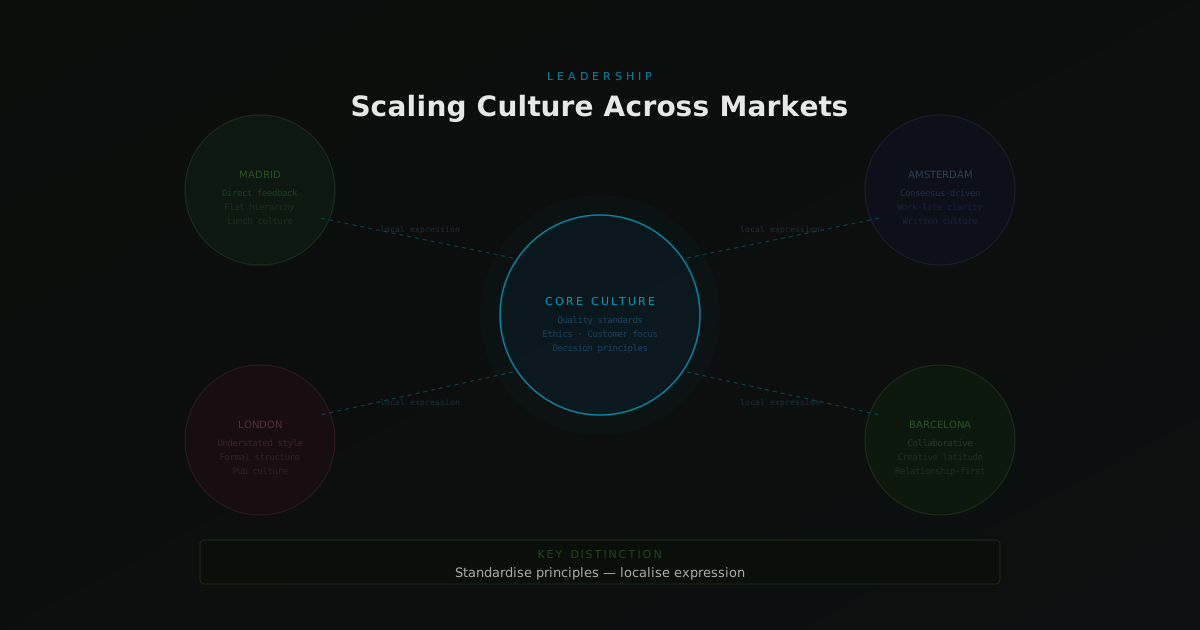
Companies that scale across multiple markets face a version of the same problem, but most don't name it correctly. They call it a culture problem when it's actually a translation problem. The values and behaviours that made the business successful in its first market are real, they're worth preserving. The mistake is assuming they can be exported identically, as if culture is a product that ships from headquarters.
What culture actually is — and isn't
Culture is not a values statement on a wall. It's not a set of principles articulated in a company handbook. Culture is what happens in practice: how decisions get made, how disagreements are resolved, how performance is recognised, how mistakes are handled. These behaviours are shaped by context, the founding team, the early customers, the market conditions, the national culture of the place the company originated.
When you expand to a new market, some of that context carries and some doesn't. The mistake is treating all of it as either universal or local. Some things are genuinely universal, the commitment to quality, the way customer problems are prioritised, the standards for how people treat each other. These need to hold everywhere. Other things are legitimately local, communication styles, management cadence, how feedback is given and received. Forcing global uniformity here doesn't produce culture. It produces resentment.
The two failure modes
Organisations that get multi-market culture wrong tend to fail in one of two ways. The first is cultural imperialism: headquarters exports the original culture wholesale, insisting on processes and practices that don't translate, and treating local variations as deviations to be corrected rather than adaptations to be understood. This produces compliance without engagement, people performing the culture rather than living it.
The second failure mode is fragmentation: each market develops its own culture, and the company loses the coherence that makes it a single organisation. Standards diverge. The brand experience varies wildly. Teams in different markets feel no connection to each other or to a shared identity. Scale becomes bureaucracy without community.
What to standardise and what to localise
The practical framework is to be explicit about which elements of culture are non-negotiable and which are locally expressed. Non-negotiable elements typically include: quality standards, ethical commitments, customer-centricity as a principle, the way the company makes decisions about what to build and what not to. These should be consistent everywhere.
Locally expressed elements include: management style, feedback culture, how meetings are run, how recognition happens, the degree of hierarchy in communication, and the pace and format of collaboration. These should be guided by principle (how we give feedback should be honest and direct everywhere) but expressed in ways that work in the local context (what "direct" looks like in Spain is different from what it looks like in the Netherlands).
The role of leadership in carrying culture
Culture travels through people, not through documents. The most effective way to maintain cultural coherence across markets is to put your strongest cultural carriers in leadership roles in new markets. Not just operational leaders, people who genuinely embody the values of the organisation and can translate them authentically into a new context.
This means that early international hires are disproportionately important. A country manager who doesn't understand the original culture, or worse, who actively adapts it out of existence, will set a trajectory that's very hard to correct. The hiring bar for these roles should be higher, not lower, even though the local market knowledge is genuinely valuable.
Building cultural connection across borders
Multi-market organisations need deliberate investment in cross-border connection, not just functional collaboration, but genuine cultural exchange. This means regular leadership interactions across markets, honest company-wide communication that includes the hard things as well as the wins, and structures that let people in different markets know and trust each other.
The companies that do this well treat culture as a living thing that needs active maintenance. They create forums for cross-cultural learning, not just top-down communication. They're genuinely curious about what's working in each market and why. And they're willing to update the core culture when new markets teach them something better.
The long game
The cultures that hold at scale are the ones that were genuinely built rather than simply stated. Companies that invested in culture as a strategic priority, not a branding exercise in their first market have something real to export. Companies that hadn't done that work find that multi-market expansion exposes the gap. There's no culture to carry because there wasn't a culture to begin with, only the informal norms of a small team that never had to be made explicit.