Most organisations approach AI adoption as if resistance is a problem to overcome. The conversation goes: here's the technology, here's why it's important, here's the training session, now use it. And then, when people don't, the conclusion is that those people are the obstacle.
This is exactly backwards. Resistance to AI in the workplace is often completely rational, and treating it as irrational makes adoption harder, not easier. The teams that successfully introduce AI into resistant groups do it by starting from a very different assumption: the resistance contains information, and that information is worth understanding before you try to change it.
Why the resistance is usually rational
People resist AI at work for reasons that, examined honestly, make a lot of sense.
Job security concerns are legitimate. The conversation about AI and employment has been dominated by optimistic projections from people who stand to benefit from AI adoption. The people who will be most affected have less reason to share that optimism. Dismissing these concerns as unfounded doesn't make them go away, it just means they're not part of the conversation.
Trust in AI accuracy is reasonable to question. Anyone who has used AI tools extensively has encountered confident errors, hallucinated facts, and outputs that were plausible but wrong. People who work in high-stakes environments, legal, financial, medical, compliance, have good reasons to be cautious about tools that can fail in ways that aren't immediately obvious.
The additional cognitive load is real. Learning to use a new class of tools effectively takes time and energy. People who already have full workloads are being asked to add this on top. The promise that it will eventually save time doesn't help with the present-tense cost of figuring it out.
Past technology promises have often not delivered. Most organisations have a track record of technology implementations that were supposed to transform how people work and didn't. Scepticism about the next one is earned, not irrational.
What doesn't work
Before getting to what works, it's worth being direct about the approaches that reliably fail.
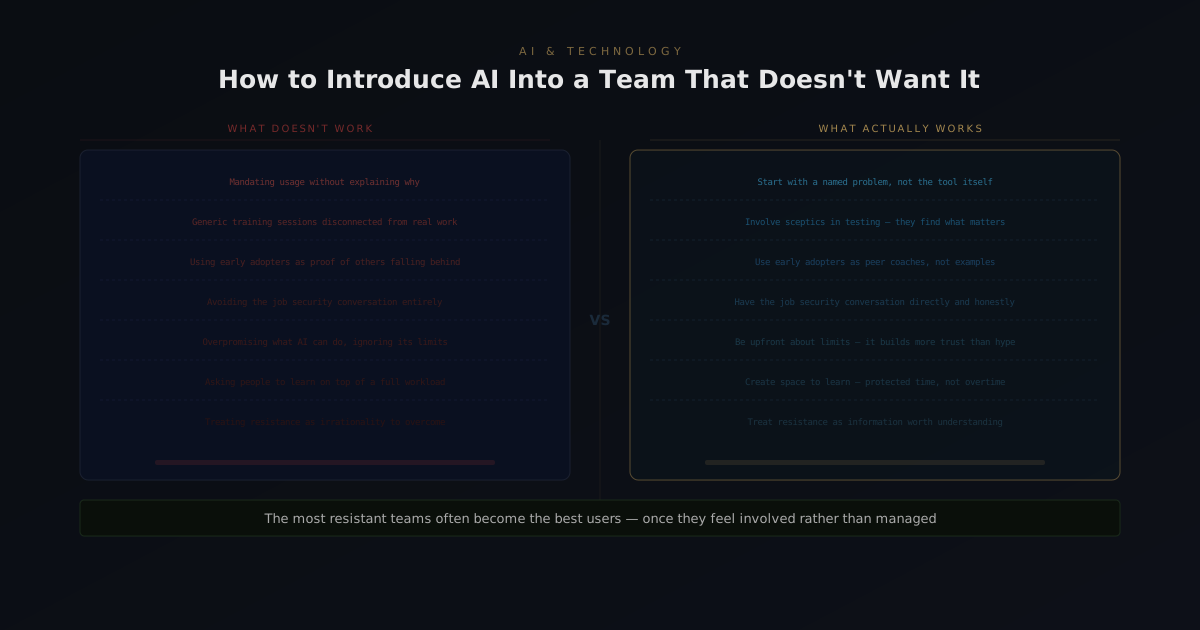
Mandating usage without context doesn't work. Telling people they must use AI tools, without explaining what problems they're solving or why those problems matter, creates compliance theatre at best, people going through the motions to satisfy a requirement, with no change in how they actually work.
Generic training sessions don't work. Showing someone how to use a tool in the abstract, disconnected from their specific work, leaves them no more able to apply it than before. They know the mechanics. They don't know what to do with them.
Ignoring the job security question doesn't work. If leaders won't have an honest conversation about what the technology means for roles and responsibilities, people will fill the silence with their own assumptions, and those assumptions are rarely optimistic.
What actually works
Start with the problem, not the tool. The most effective AI introductions begin with a specific, named pain point that people in the team already experience. Not "AI can help with lots of things" but "the way we do X right now takes three hours and the output is often inconsistent, let's look at whether this tool helps." The tool becomes a means to an end rather than an end in itself.
Involve sceptics in the design. The people who are most resistant are often the most rigorous. If you can get them involved in testing and evaluating AI tools with explicit permission to find the limitations, you accomplish two things. You get better feedback than you'd get from enthusiasts, and you build ownership in people who would otherwise be obstacles. Sceptics who find genuine value become the most credible advocates.
Be honest about the limits. Nothing destroys credibility faster than overpromising what AI can do and having people discover the limitations themselves. Being upfront about what the tools can't do, where they're unreliable, and what human judgment is still required actually increases trust rather than decreasing it.
Make the time investment visible. Acknowledge that learning a new way of working takes time that people don't currently have. Either create space for it explicitly, protected time, reduced other workload, or don't be surprised when it doesn't happen. The adoption cost is real and needs to be budgeted for.
Have the job security conversation directly. This is uncomfortable and most leaders avoid it. But refusing to have it doesn't make the concern disappear. A direct, honest conversation about how roles may evolve, what the organisation's intention is, and how people will be supported through change, even if the answers are uncertain, is far better than silence.
The role of early adopters
In every team, there are people who are genuinely curious about AI and eager to experiment. These early adopters are valuable, but only if you use them correctly.
The instinct is to treat early adopters as proof points: look how productive they are, why can't everyone do this? This creates resentment rather than inspiration. People who are already sceptical don't respond well to being told they're falling behind.
A better use of early adopters is as peer coaches. When a colleague demonstrates a tool in the context of work you both do, for a problem you both recognise, the learning is far more transferable than anything a training session can achieve. The messenger matters as much as the message.
What sustainable adoption actually looks like
Sustainable AI adoption doesn't look like everyone using a tool because they were told to. It looks like specific workflows being genuinely redesigned around AI capabilities, with the people who do that work having been involved in the redesign.
It happens at the speed of trust. Organisations that rush to mandate adoption typically end up with surface-level compliance and no underlying change. Organisations that take the time to address concerns honestly, demonstrate value in context, and give people real agency in how they use new tools end up with adoption that sticks.
The teams that resist AI loudest often become its best users, once they understand it properly, see how it serves them rather than threatens them, and have had a hand in shaping how it's introduced. Treating their resistance as information rather than obstruction is the essential first step.