The standard PM interview process is almost perfectly designed to hire the wrong person. It rewards articulate presentation, framework fluency, and the ability to produce a convincing product critique under time pressure. All of these are real skills. None of them are the primary skills required to ship software in a real company with real constraints and real stakeholders.
I've hired a lot of product managers over two decades. The best ones I've worked with often struggled in conventional interviews. The worst ones were usually excellent in them. That correlation is uncomfortable enough that it eventually changed how I hire.
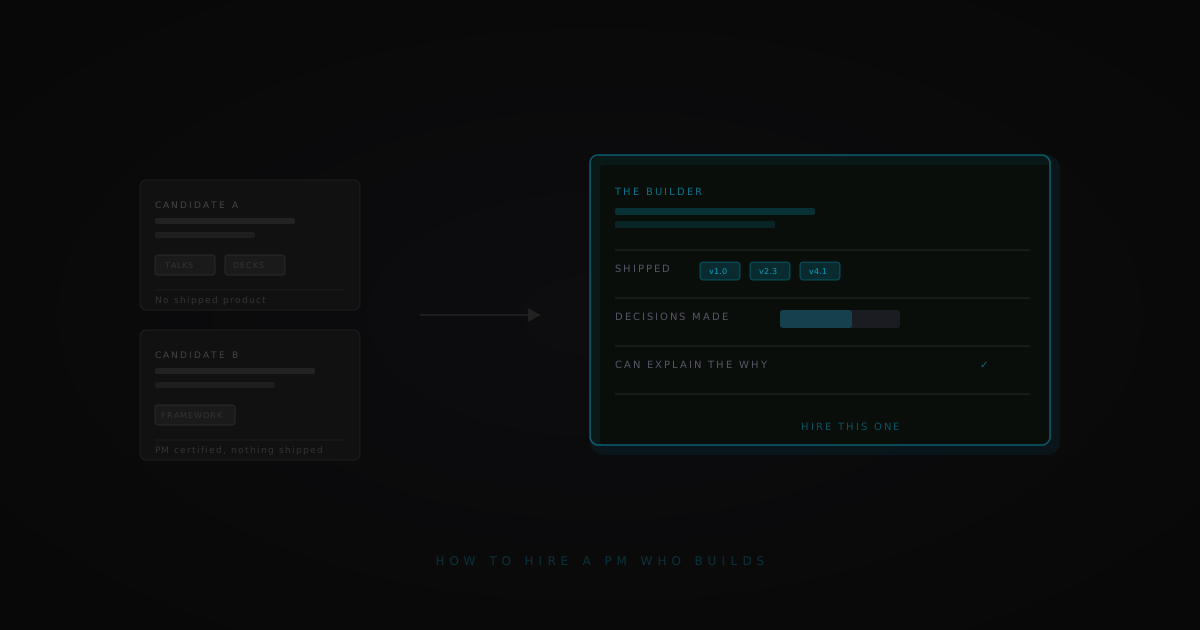
The difference between a presenter and a builder
A presenter knows the frameworks. They can articulate customer journey maps, JTBD theory, OKR alignment, and the difference between outcome-based and output-based roadmaps. In an interview they come across as thoughtful, rigorous, and aligned with best practice. They are also, quite often, genuinely good at these things. The problem is that frameworks aren't the job. The job is making decisions under uncertainty with incomplete information, keeping engineers motivated through ambiguity, and shipping things that work.
A builder's interview often goes differently. They say things like "we made a bad call on that, here's what we learned" or "I pushed the team to ship before it was ready because the market window was closing — it worked, but I wouldn't do it exactly the same way again." They remember specific numbers. They remember the names of engineers they worked with. They have opinions about what made a particular product worse, not just better.
The builder's answers are messier. But the mess is the signal. Real product work is messy. Candidates whose work sounds clean either haven't done much of it or haven't been honest about it.
The four questions that reveal builders
"Tell me about a feature you shipped that you wish you hadn't." This question reveals whether someone has genuine accountability for their decisions. Presenters talk about what the team could have done better. Builders say "I" and give you a specific example, a specific outcome, and what they actually learned. The absence of first-person language in a response to this question is a red flag.
"Walk me through how you made the last difficult prioritisation decision." Not "how do you prioritise in general" — that gets you a framework recitation. The specific last decision. What were the options? Who disagreed? What information did you not have? What happened after you decided? A builder can answer this in detail. A presenter gives you the theory.
"What's the worst feedback you've ever received from an engineer about how you work?" The answer to this question tells you whether the candidate has worked closely enough with an engineering team for them to have formed a real opinion about them. If the candidate can't remember any specific critical feedback, they either haven't been told, haven't listened, or are not being honest. None of those are good.
"Show me something you shipped." Not a case study. Not a deck. The actual product. On a phone, on a laptop — something they can click through. The builders always have something. They open it quickly, they know all the edge cases, and they'll tell you what's wrong with it before you ask.
Ask for the thing they shipped. Not the deck they made about it.
What to look for in the CV before you meet them
The CV signal is simpler than most people think. Look for specific outcomes, not responsibilities. "Launched X, resulting in Y% improvement in Z" is a builder's CV line. "Responsible for product roadmap across three product areas" is a presenter's.
Look for tenure that suggests they actually shipped something. A PM who moved every 14 months probably never got a product to a state where they had to live with the consequences. The builders tend to stay until the thing is done — or until they've clearly understood why it didn't work.
Look for a pattern of working close to the user. Support tickets read. Customer calls attended. On-site visits done. This work doesn't get listed on CVs as much as it should, which is why you have to ask about it.
The two types of PM your business needs
Not every PM role is the same. A PM building 0-to-1 products in an ambiguous problem space needs a different profile from a PM optimising and scaling a product that already works. The 0-to-1 PM needs high tolerance for uncertainty, a strong point of view about the user, and the confidence to say "we need to change direction." The scaling PM needs rigour, strong stakeholder management, and the ability to get things done through a larger organisation without formal authority.
Confusing these two profiles is one of the most common hiring mistakes in product teams. The brilliant 0-to-1 PM is sometimes terrible at scale. The rigorous scaling PM sometimes can't deal with the ambiguity of early-stage work. Both are valuable. Be honest about which you actually need before you start.