Every digital transformation starts with a budget conversation. And most of those conversations go wrong in the same way: the budget is structured around what the company plans to buy and build, rather than what it is trying to change. The result is a budget that looks ambitious on paper but doesn't fund the things that actually determine whether transformation succeeds.
Why most digital budgets fail before they start
The typical digital transformation budget is a list of line items: new platform licence, systems integration, new hires, change management programme, training. These are real costs. But organising a budget this way creates three problems.
First, it makes it impossible to evaluate trade-offs. When the budget is squeezed, and it always is, it's very hard to know which line items matter most to the outcome. Second, it disconnects spend from accountability. Nobody is clearly responsible for whether the investment delivers business results, only whether the project ships on time. Third, it under-invests in change management, because that line item always looks easy to cut.
The three buckets that actually matter
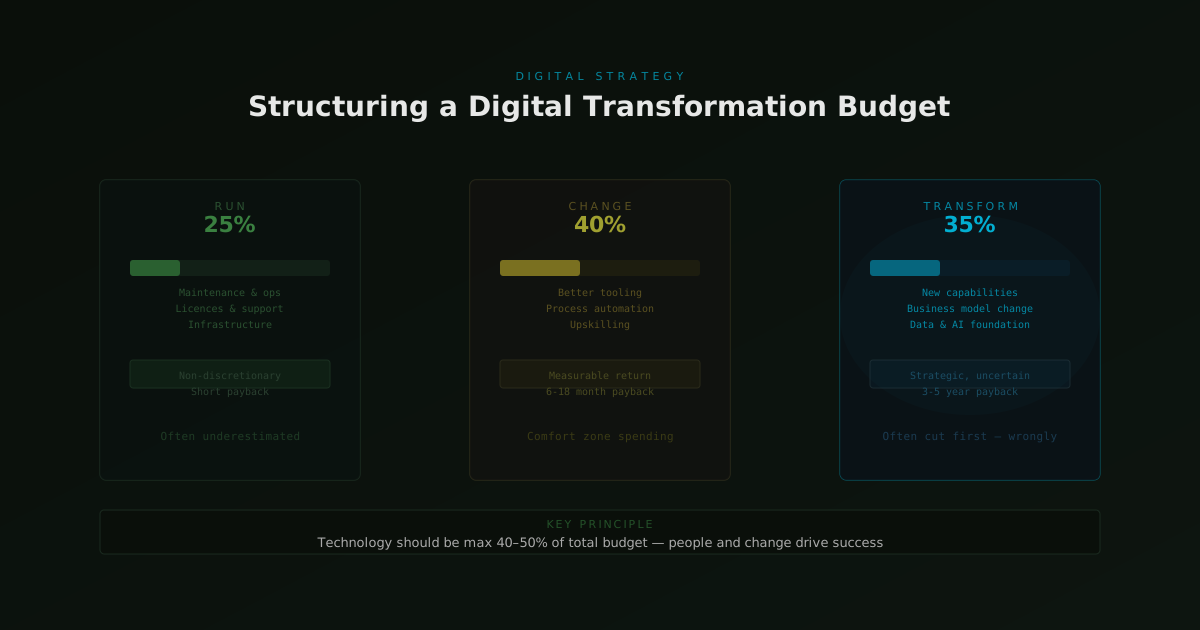
A better framework organises digital investment into three categories: run, change, and transform. These reflect the different nature of the work and the different return profile of the investment.
Run is the cost of keeping existing digital systems working, maintenance, licences, operations, support. This is non-discretionary spending that's often underestimated. Many organisations treat it as zero in their transformation budget calculations, which leads to hidden cost problems later.
Change is investment in improving existing capabilities, better tooling, more automation, faster processes. This has a relatively predictable return and shorter payback period. It's where most organisations are most comfortable spending.
Transform is investment in genuinely new capabilities, new business models, new customer experiences, new data capabilities. This has the highest potential return but also the highest uncertainty and longest payback. It's where most transformation ambition lives, but where budget tends to be squeezed first.
Where the money actually goes — and where it should
In practice, most digital budgets are heavily skewed toward technology spend and under-invested in people and change. A rough rule of thumb: technology should represent no more than 40-50% of a transformation budget. The rest should go to people capability (hiring, upskilling, backfilling roles), change management and adoption (which is not the same as training), and the operational overhead of running the transformation itself.
The most common mistake is treating change management as a residual, whatever is left after the technology is funded. This is exactly backwards. Technology without adoption delivers nothing. The investment in getting people to actually use the thing is often more important than the thing itself.
Making the case to leadership
Digital transformation budgets are often challenged because they're hard to evaluate against traditional investment criteria. The returns are uncertain, the timelines are long, and the benefits are often distributed across the organisation rather than showing up in a single P&L line.
The most effective approach is to be explicit about this rather than trying to fit transformation investment into standard ROI frameworks. Distinguish between efficiency investments (clear payback, measurable in months) and capability investments (strategic, payback in years). Present both honestly. Leadership teams that understand what they're buying are better at protecting the budget when it matters.
Staging the investment
Digital transformation budgets should be staged, not committed upfront. The first stage funds discovery and foundation-setting: understanding the current state, identifying the highest-value opportunities, and establishing the platforms and practices that everything else builds on. This should be a relatively modest investment with clear deliverables.
Subsequent stages should be contingent on outcomes, not just timelines. If stage one reveals that a particular technology choice was wrong, the staged approach gives you an exit. If it validates the direction, it gives you the evidence to invest more confidently. Locking in a three-year transformation budget at the start is a failure mode, the assumptions that underpin it will be wrong.
Measuring return on digital investment
The hardest part of digital transformation budgeting is accountability for outcomes. Technology vendors will give you usage metrics. Project managers will give you delivery milestones. Neither tells you whether the investment is working.
The best digital budgets have business owners, not technology owners, accountable for the outcomes. A new customer platform doesn't succeed when it launches, it succeeds when customer satisfaction improves, or acquisition costs fall, or revenue per customer grows. Those business metrics need to be established before the investment is approved, and they need to be tracked rigorously throughout. If you can't define what success looks like in business terms, you shouldn't approve the budget.