Marketplaces are one of the most compelling business models in digital, and one of the hardest to build. The promise of connecting buyers and sellers at scale, taking a margin on every transaction, and becoming more valuable as the network grows is genuinely powerful. The problem is that most marketplaces fail before they get anywhere close to that flywheel turning.
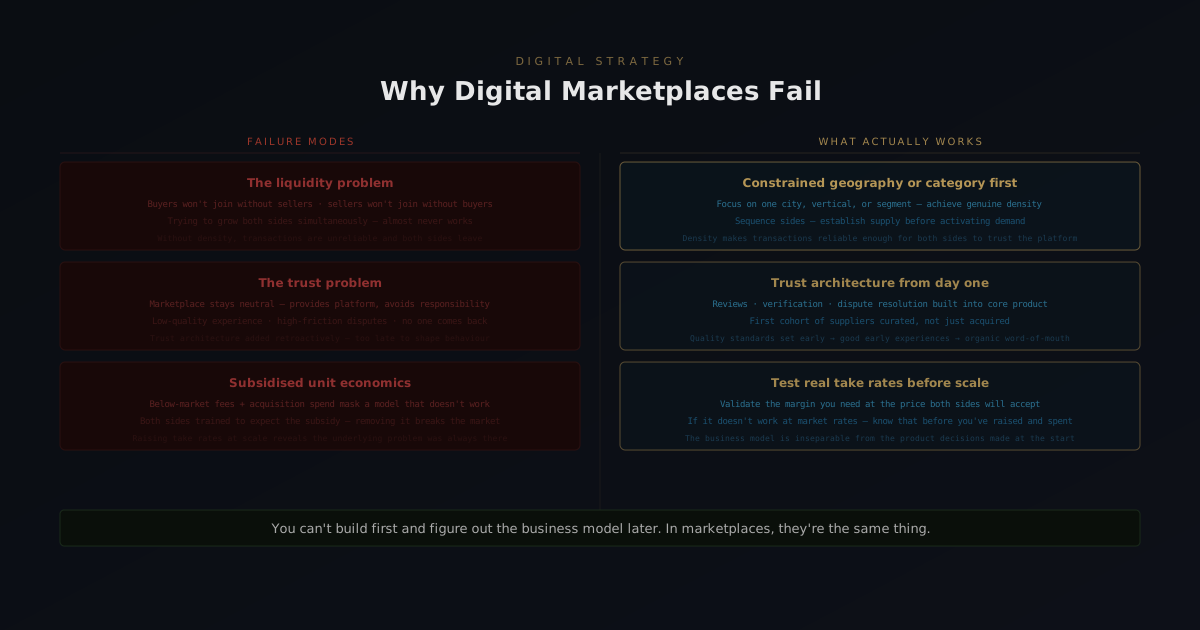
Every marketplace faces the same structural challenge at the start: buyers won't join without sellers, and sellers won't join without buyers. This chicken-and-egg problem is not a temporary inconvenience, it's the primary reason most marketplace businesses fail. If you can't solve it, the model doesn't work, regardless of how good the product is.
The mistake most founders make is trying to solve both sides simultaneously. Launching with a marketing campaign targeting buyers and a separate effort to recruit sellers, hoping both grow in parallel, almost never works. The sides need to be sequenced, and usually the better approach is to establish critical mass on one side first, typically supply before activating demand.
Marketplaces connect strangers. Whether it's a homeowner with a tradesperson, a guest with a host, or a buyer with a seller, neither party knows the other in advance. Who bears the risk when something goes wrong? What happens when the service isn't delivered? What happens when payment is disputed?
The answer to these questions determines whether the marketplace creates trust or simply transfers risk. Marketplaces that try to remain neutral, providing a platform without taking responsibility for outcomes, tend to produce low-quality experiences and high-friction disputes. The ones that build trust architecture into the core product (reviews, verification, insurance, dispute resolution, guarantees) are more expensive to operate but significantly more valuable to both sides.
Most marketplace businesses subsidise growth. They offer below-market fees to attract early suppliers, run campaigns to bring in initial demand, and tolerate negative unit economics in the belief that scale will fix it. Sometimes it does. More often, the subsidy becomes structural, both sides have been trained to expect it, and raising take rates or reducing acquisition spend surfaces the fact that the model doesn't actually work at market rates.
Before scaling, it's worth being honest about what your unit economics look like without subsidies. If a transaction on your platform isn't profitable at the price both sides would naturally accept, either the value proposition isn't strong enough or the market isn't big enough. Neither problem is solved by growth alone.
As marketplaces mature, they often build increasingly sophisticated tools to help suppliers operate more effectively on the platform. Better inventory management, analytics, payment processing, marketing tools. At some point, these tools become so central to how suppliers run their businesses that the marketplace is no longer just a distribution channel, it's an operational dependency. This seems like a competitive advantage, but it creates a structural tension: the more the platform knows about supplier operations, the better positioned it is to disintermediate them.
This pattern has played out in retail, travel, logistics, and B2B software. Suppliers start on the marketplace because they need the demand. They stay because the platform has become operationally embedded. They become vulnerable because the platform can see exactly where the margins are. Understanding this trajectory before you build is useful, both if you're the marketplace builder and if you're the supplier considering whether to rely on one.
The marketplaces that reach liquidity and hold it tend to do several things consistently:
Marketplaces are not a product category where you can build first and figure out the business model later. The business model is inseparable from the product decisions made at the beginning.