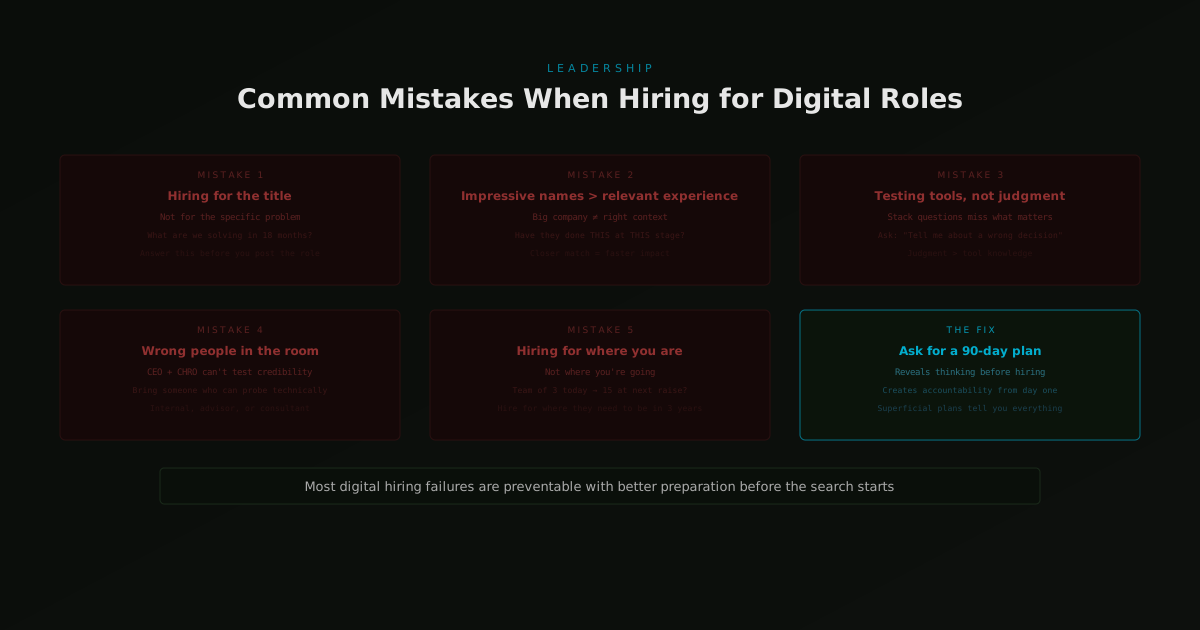
Most businesses that struggle with digital transformation have made at least one significant hiring mistake in a senior digital role. Not because they hired bad people, usually they hired people who were perfectly competent in the wrong context, or who had exactly the wrong skillset for what the business actually needed.
Digital hiring is genuinely difficult. The roles are relatively new. The language is inconsistent across industries. And the people doing the hiring, usually a CEO or CHRO who came up through a non-digital function, don't always have the frame to evaluate candidates accurately. The result is a pattern of predictable mistakes.
Hiring for the title rather than the problem
The most common mistake is deciding to hire a CDO, CTO, or VP of Digital without first being specific about what problem the role is solving. The title implies a function, but the actual requirements vary enormously depending on where the business is in its digital journey.
A CDO in a business that needs to build its first coherent digital infrastructure is a completely different hire from a CDO in a business that has mature infrastructure but poor data governance. A CTO who is brilliant at scaling engineering teams is the wrong person to hire if what you need is someone to evaluate and integrate new AI tools into operations.
Before writing the job spec, the question to answer is: what is the specific problem we need this person to solve in the first 18 months? If you can't answer that clearly, you're not ready to hire yet.
Prioritising impressive names over relevant experience
Digital hiring is full of impressive CVs that don't translate. A candidate who ran digital at a large FMCG company brings very different experience from one who built a digital platform from scratch at a Series B startup. Neither is inherently better, but one of them is dramatically better for your specific situation.
The most valuable question to ask is not "what impressive things has this person done?" but "have they done the specific thing we're trying to do, at a comparable stage of company, in a comparable context?" The closer the match, the shorter the learning curve and the faster the impact.
This is especially important for AI and data roles. Someone who built a sophisticated data science function at a large company where there was already clean infrastructure and a dedicated data engineering team may struggle enormously in a business where they need to build the data foundations from scratch while also maintaining stakeholder relationships and contributing to a product roadmap.
Evaluating on technical knowledge rather than judgment
Non-technical interviewers tend to compensate for their inability to assess technical depth by asking about tools and technologies. "What platforms do you use? What stack are you comfortable with? Do you know X framework?"
These questions are largely useless for senior digital hires. The technology changes fast enough that specific tool knowledge is almost always trainable. What matters far more, and what's much harder to assess, is whether the person has good judgment about when to use which approach, how to make trade-offs under pressure, and how to explain technical decisions to non-technical stakeholders.
Better interview questions look like: "Tell me about a technology decision you made that turned out to be wrong. How did you know, and what did you do?" or "Walk me through how you'd approach our situation, given what you know so far."
Not involving the right people in the interview process
A digital hire who is being assessed purely by the CEO and the CHRO is being assessed by people who almost certainly can't evaluate the candidate's technical credibility. And a candidate who can't be evaluated on technical credibility will be assessed entirely on communication style and cultural fit, which systematically biases toward people who are articulate and likeable but not necessarily capable.
The fix is to involve at least one person who can have a substantive technical conversation in the interview process, whether that's an existing technical leader internally, a trusted advisor, or an external consultant. Their role is not to run the final decision but to give the hiring team a view on whether the candidate's technical claims hold up under scrutiny.
Hiring for where you are rather than where you're going
Businesses often hire digital leaders based on what the business currently looks like. But by the time the person is fully onboarded and functional, typically 6–9 months, the business will have changed. And the digital leader needs to be ahead of where the business is going, not managing where it's been.
This means thinking explicitly about what you'll need from this person in 3 years, not just in 3 months. If you're hiring a Head of Product who will be managing a team of 3 today, but the plan is for that team to grow to 15 by the time of your next raise, you need to hire someone who has built and managed teams of 15 before, not just someone who will be good at managing a team of 3.
Skipping the 90-day plan
One of the most useful tools in digital hiring, and one of the most frequently skipped, is asking final candidates to produce a draft 90-day plan. This does several things at once. It reveals how the candidate thinks about priorities. It shows whether their instincts align with what the business actually needs. And it creates an accountability document that the successful candidate can be held against.
Candidates who refuse or produce a superficial document are telling you something important. Candidates who produce a detailed, thoughtful plan that demonstrates they've genuinely engaged with the brief are demonstrating exactly the diagnostic capability that makes a great digital leader.
Getting digital hiring right is hard. But most of the mistakes are avoidable with better preparation before the search starts, a clearer problem definition, more specific success criteria, and a more structured evaluation process. The investment in getting this right at the start is always worth it.