Most AI adoption content is written with large enterprises in mind, teams of data scientists, substantial IT budgets, and the luxury of multi-year transformation programmes. For the leader of a fifty-person professional services firm, a hundred-site retail group, or a growing manufacturing business, that content is largely irrelevant.
The questions SME leaders are actually asking are simpler and more immediate: Where should we start? What will it cost? What are the real risks? How do we know if it is working? This guide attempts to answer those questions without the enterprise framing.
The SME Advantage
Before discussing where to start, it is worth acknowledging that SMEs have some genuine advantages over large organisations when it comes to AI adoption. Decision-making is faster. Organisational politics are simpler. The gap between a tool being adopted and it having visible impact is shorter. And the cost of experimentation, relative to the organisation's scale, is often manageable.
Large enterprises struggle with AI adoption not because they cannot access the technology, but because integrating it into complex, politically charged organisations with legacy systems and entrenched processes is genuinely hard. An SME that can make a decision, trial a tool with a small team, and see whether it works within a month has an agility advantage that should not be underestimated.
Where Most SMEs Start (and Why It Often Fails)
The most common SME AI adoption pattern is: a leader or manager discovers ChatGPT or a similar tool, starts using it personally, enthusiasm spreads informally through the organisation, a few people become heavy users, most people continue doing things the way they always did, and nothing changes systemically.
This is not entirely without value, individual productivity gains are real, and informal adoption builds familiarity. But it does not create organisational capability, does not address the processes where AI could have the most impact, and often creates governance problems (data being shared with consumer AI tools that were never assessed for business use).
A more deliberate approach produces better results.
Step 1: Start With Productivity, Not Transformation
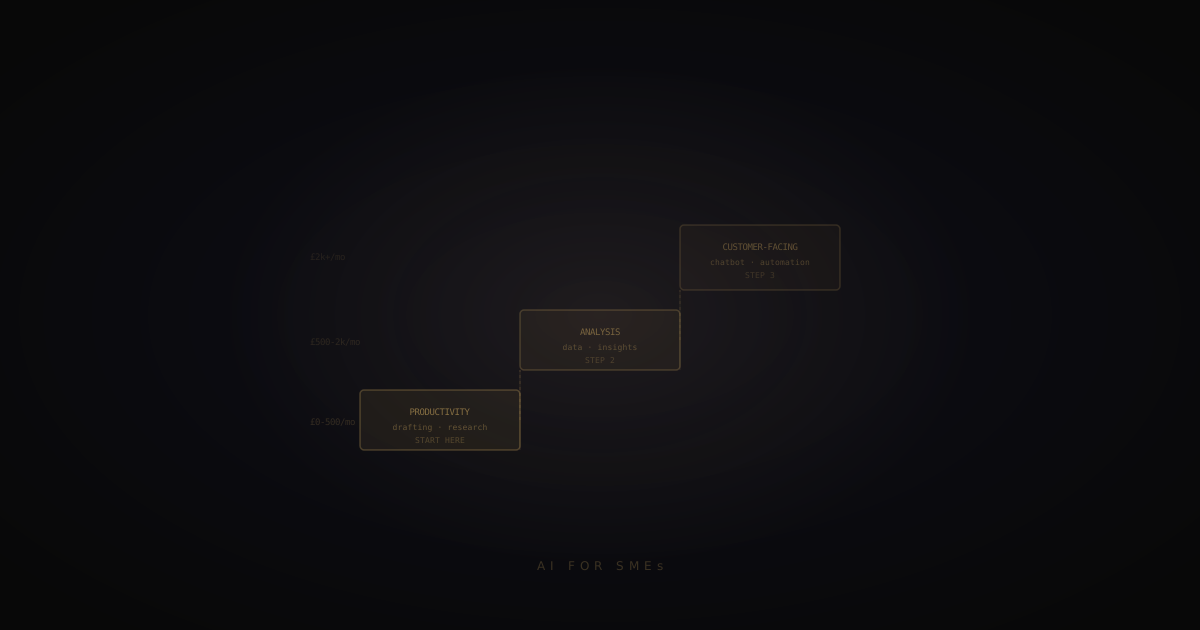
The most reliable first step for almost any SME is deploying AI tools that increase individual and team productivity. This means AI writing assistants, meeting summarisation tools, research and synthesis tools, and similar applications that augment existing workflows rather than replacing them.
The reasons to start here are practical. The tools are accessible and inexpensive (most are £20–50 per user per month). The risk is low if a draft needs editing, the cost is a few minutes. Adoption is faster because people can see immediate personal benefit. And success builds the confidence and fluency that makes more ambitious applications feasible later.
Concrete examples that deliver visible value in most SME contexts: AI-assisted proposal and bid writing, meeting notes and action item extraction, research and briefing document drafting, first-draft email and communication writing, and policy or process document drafting. None of these require technical expertise to implement or use.
Step 2: Identify Your Highest-Value Processes
Once the organisation has basic AI fluency, people understand what these tools can and cannot do, and have developed habits of using them, the next step is identifying where AI can have material business impact beyond individual productivity.
A useful exercise is to map the ten most time-intensive or error-prone processes in your business and ask: which of these involve significant manual processing of information or documents? Which involve repetitive decision-making against consistent criteria? Which involve synthesising large amounts of data to produce reports or recommendations?
These are the processes most susceptible to AI augmentation. Common examples in SME contexts: customer onboarding documentation processing, contract review and comparison, supplier invoice processing, customer query handling and triage, compliance reporting, and data analysis and reporting cycles.
Step 3: Pilot Before Deploying
The most expensive AI adoption mistakes come from deploying at scale before validating that the tool works as expected in your specific context. AI tools that perform well in general benchmarks sometimes perform poorly on domain-specific content, in specific languages or registers, or with the particular data formats your business uses.
Run a structured pilot of any significant AI deployment before rolling out widely. Define what success looks like in advance (output quality, time saving, error rate), run the pilot with a small group for four to eight weeks, measure against your success criteria, identify the failure modes and edge cases, and then decide whether to proceed, adjust, or abandon.
Pilots do not need to be elaborate. A team of five people using a new tool for six weeks and tracking whether it is actually saving them time and producing useful outputs is sufficient to inform most SME adoption decisions.
The Budget Question
Many SME leaders assume AI adoption requires significant upfront investment. For the first stage, productivity tools, the costs are genuinely low. Licensing a business AI assistant for a team of twenty costs less than a monthly agency retainer. The ROI calculation is simple: if the tool saves each person two hours per week and their time costs £40 per hour, you are generating £1,600 per person per month in value from a tool that costs £30 per person per month.
For more substantial AI applications, custom integrations, process automation, AI-augmented workflows, costs rise, but so does the potential value. A realistic budget framework for an SME:
- £0–500/month: Productivity tools for the team. ChatGPT, Claude, or Microsoft Copilot licences. No integration work required.
- £500–2,000/month: Specialist tools for specific functions (legal AI, finance AI, CRM AI features) plus basic process integration. Some internal configuration time required.
- £2,000+/month: Custom AI workflows, significant process automation, or customer-facing AI applications. Requires technical resource to implement and maintain.
Start at the first tier. Move up when you have evidence that the investment delivers value and when you have the internal capability to manage more complex tools.
The Governance Minimum
SMEs do not need an extensive AI governance framework to start adopting AI tools. But a few basics are worth establishing early:
- A sanctioned tools list: Which AI tools are approved for business use? This prevents employees using consumer tools that were never assessed for data handling compliance.
- Data classification rules: Which types of information can be shared with AI tools? Customer personal data, commercially sensitive information, and regulated data need explicit guidance.
- Output review expectations: Establish that AI-generated content requires human review before use in customer-facing or consequential contexts. This sounds obvious; without stating it explicitly, it often does not happen.
A one-page AI policy covering these three points is sufficient for most SMEs at the outset. It can grow in sophistication as the organisation's use of AI grows in complexity.
What Good Looks Like at 12 Months
For an SME that starts from scratch and follows a deliberate adoption process, twelve months is enough time to: have widespread AI fluency across the team, have identified and piloted at least one significant process improvement, have basic governance in place, and have a clear view of where the next phase of investment should go.
That is not transformation. But it is a solid foundation, and it positions the business to make more ambitious and better-informed decisions about AI in the subsequent period. The organisations that will benefit most from AI over the next five years are not the ones that move fastest in 2026. They are the ones that build genuine capability, governance, and fluency in a way that compounds over time.
That is within reach for almost any SME that approaches it deliberately.