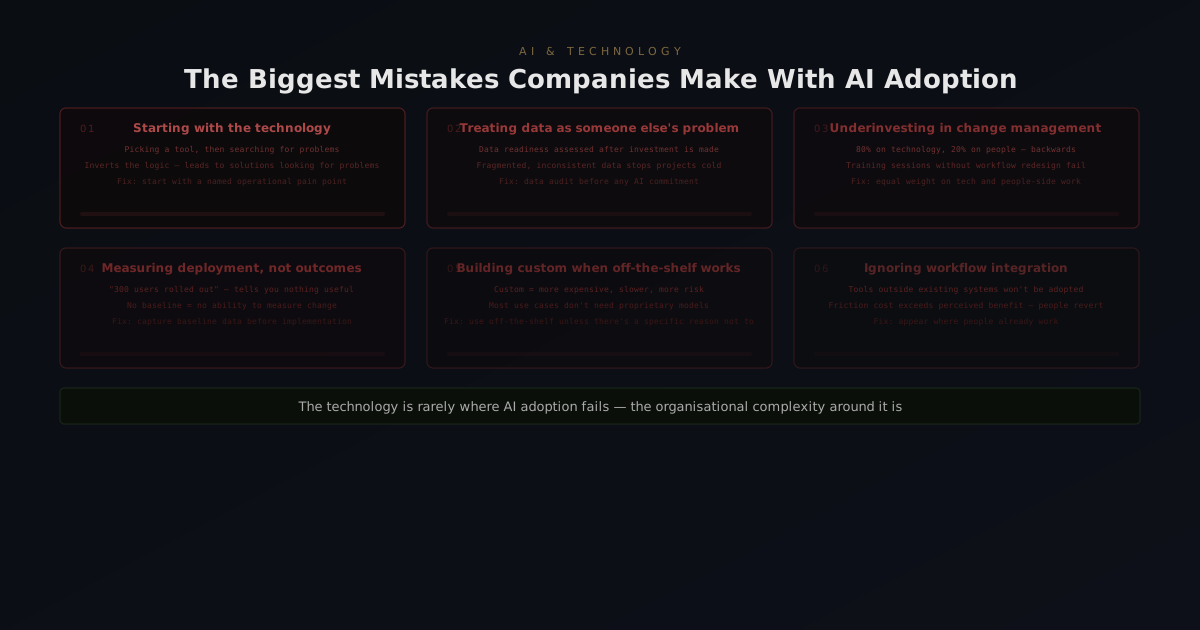
AI adoption failures follow a pattern. Having watched organisations attempt it across a range of industries and sizes, the same mistakes appear with enough regularity to suggest they're structural, built into how organisations typically approach new technology, rather than just individual errors of judgement.
The good news is that patterns are predictable, and predictable problems are solvable. Here are the mistakes that come up most consistently, and what to do instead.
Starting with the technology, not the problem
The most common mistake is deciding to "implement AI" and then looking for places to apply it. This inverts the logical order. Technology is a means to an end, not an end in itself. Starting with the tool means you spend significant time and money searching for problems that fit the solution you've already committed to.
The productive order is the reverse: identify a specific, well-understood operational problem that is causing measurable pain, and then evaluate whether AI is the right tool to solve it, alongside automation, process redesign, and other options. This framing changes everything, from how you evaluate success to how you get buy-in from the people who will use the output.
Treating data readiness as someone else's problem
Almost every AI project eventually hits the same wall: the data isn't ready. It's fragmented across systems. It's inconsistently formatted. It's missing fields that turn out to be critical. The historical records don't go back far enough. Nobody knows who owns which dataset.
These problems are entirely predictable if you look for them before starting. The mistake is treating data readiness as a parallel track rather than a prerequisite, discovering the issues after significant investment has already been made in the AI layer. Data infrastructure assessment should happen before, not during, implementation.
Underinvesting in change management
Organisations consistently spend more on the technology than on the change. A typical ratio might be eighty percent on tools and twenty percent on the people-side work: training, communication, workflow redesign, stakeholder management. It should probably be closer to fifty-fifty, at least in the early stages.
This isn't just about training sessions. Real change management means involving the people who will use the outputs in the design process, addressing concerns openly, redesigning workflows rather than just layering tools on top of existing ones, and building the feedback loops that let you identify where adoption is stalling before it becomes a sunk cost.
Measuring deployment instead of outcomes
"We've rolled out AI to three hundred users" is a deployment metric. It tells you nothing about whether anything has changed. The mistake is treating deployment as success and stopping the measurement there.
The metrics that matter are outcome metrics: has decision quality improved? Has processing time reduced? Has error rate decreased? These are harder to measure and require baseline data to be captured before the implementation, which most organisations skip. Without baseline data, you can't measure change, and without measuring change, you can't tell whether the investment was worthwhile.
Building custom when off-the-shelf is sufficient
There's a persistent tendency to treat custom AI development as more prestigious than using off-the-shelf solutions. Custom builds generate more internal excitement, create visible technical work, and feel like proper AI strategy. They're also more expensive, take longer, and carry more risk.
For the vast majority of business use cases, configuring an existing vendor solution or building a thin layer on top of foundation model APIs is faster and cheaper than building from scratch, and produces similar outcomes. Custom development makes sense when you have a genuinely proprietary dataset, a highly specific domain problem, or a competitive advantage that depends on a capability nobody else offers. For everything else, off-the-shelf is usually the better choice.
Ignoring integration into existing workflows
AI tools that require people to leave their existing systems, reformulate their requests in new interfaces, and then translate outputs back into their normal workflow will not be adopted. The friction cost is too high relative to the benefit, and people will default to their familiar approach.
Effective AI integration appears where people already work. This means building into existing tools, CRM systems, communication platforms, project management software, rather than creating parallel applications. It means outputs that are in the format and location where people need them. This is often harder to build than a standalone tool, but it's the difference between adoption and abandonment.
Skipping the pilot-to-production transition plan
Pilots succeed. Production deployments stall. The gap between the two is consistent enough that it deserves its own planning attention, and most AI implementations treat it as a detail rather than a distinct problem.
The pilot environment is controlled, enthusiastic, and closely monitored. Production is messy, staffed by people who weren't in the pilot, and competing with dozens of other priorities for attention. The transition requires explicit planning: how will the tool be supported? Who owns issues when they arise? How does feedback get back to the team that built it? These questions need answers before production begins, not after the first problems appear.
The underlying pattern
What connects these mistakes is a consistent underestimation of the organisational complexity of AI adoption. The technology is often the easy part. The hard parts, aligning people, preparing data, redesigning workflows, measuring outcomes, managing change, are harder, less visible, and less glamorous. They're also where most implementations succeed or fail.
Organisations that have a realistic model of that complexity from the beginning, that plan for it, resource it, and treat it as core to the project rather than peripheral to it, are the ones that consistently get AI working.