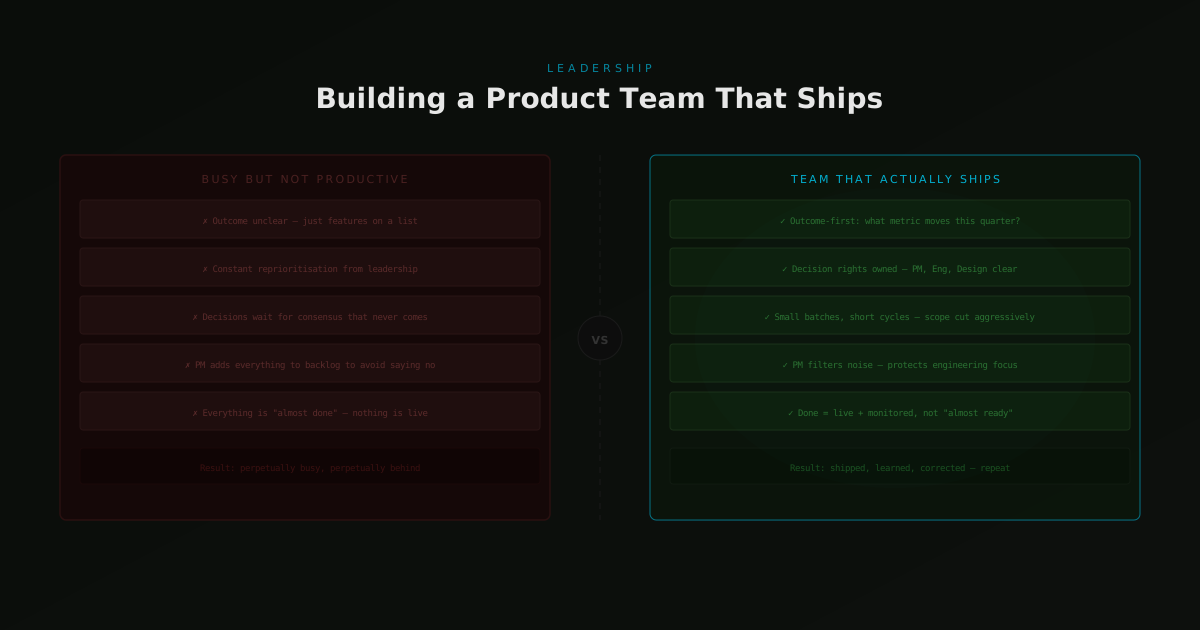
There's a particular kind of product team that looks, from the outside, like it's doing everything right. Sprint planning. Retrospectives. A backlog groomed to within an inch of its life. Roadmap reviews. Stakeholder demos. And yet the thing, the actual product, barely moves. Features take months to ship. Fixes linger in review. The team is perpetually busy and perpetually behind.
This is not a methodology problem. You can't fix it with a better Jira setup or a different agile framework. It's a leadership and culture problem, and it requires a different diagnosis.
Clarity of outcome, not clarity of task
Teams that don't ship well are usually teams that have been given very clear tasks but very unclear outcomes. The backlog is full of features, specific, well-described, estimated. But nobody can answer the question: what result are we trying to achieve, and how will we know if we got there?
This matters because tasks without outcomes can't be prioritised. When everything on the backlog sounds equally plausible, everything gets deprioritised in favour of whatever the last person to speak to the PM asked for. And the constant reprioritisation is exactly what kills velocity, not because the team is slow, but because it keeps being redirected before it builds momentum in any direction.
The shift that matters here is moving from "what are we building this sprint?" to "what metric are we trying to move this quarter, and what's our best bet on how to move it?" This changes how the team reasons about trade-offs and gives it the ability to say no to things that don't connect to the outcome.
Decision rights, clearly owned
Most product teams are slow because decisions are slow. Not because anyone is lazy because it's unclear who has the authority to make a given call.
The PM wants to ship a simplified version. Engineering thinks the full version is necessary for technical reasons. Design has concerns about the UX. The CEO has a view they shared in passing three weeks ago. Everyone is waiting for consensus. Consensus never arrives. The feature sits in review.
High-velocity teams have resolved this in advance. The PM owns the what and the why. Engineering owns the how and the when. Design owns the experience quality. These aren't just aspiration statements, they're enforced by who actually makes the call when there's disagreement, and who gets overruled if they overstep their domain.
The CEO role in this is particularly important. Founders who can't resist providing a view on every product decision, even when they've hired a product team specifically to make those decisions, will consistently slow the team down. The cost of every "just one more thought from the founder" is measured in days of delay and weeks of eroded team confidence.
Small batches, short cycles
Teams that ship valuable things consistently don't ship large things infrequently. They ship small things often. This is not just a best practice, it's the mechanism that allows a team to learn and correct.
A feature that takes three months to build and then turns out not to move the needle is a much more expensive failure than a feature that takes two weeks to build, turns out not to move the needle, and teaches you something about user behaviour you didn't know before.
The discipline required is cutting scope, aggressively and repeatedly. Most product teams resist this because scope reduction feels like failure. But shipping a smaller thing that works is always better than not shipping a larger thing that's almost ready.
A culture of done, not almost done
Almost done is the enemy of shipped. Almost done means it's in QA. Almost done means the PM hasn't signed off. Almost done means the edge cases haven't been handled. Almost done is where features go to die.
Teams with high shipping velocity treat "done" as a precisely defined state, not "code complete" but "live in production, monitored, with known metrics to evaluate against." Everything before that state is in progress, not done. This sounds like a trivial distinction until you've watched a team spend three weeks on features that are each individually "almost done."
Protecting the team from the noise
One of the most underrated leadership contributions in product is absorbing noise. Every product team has a stream of incoming requests from sales, from customer success, from the CEO, from individual customer calls. If that stream reaches the engineering team unfiltered, it destroys focus.
The PM's job is to be a filter, not a translator. The difference is that a translator passes through anything that sounds reasonable. A filter evaluates everything against the outcome the team is trying to achieve and absorbs the pressure from stakeholders who are disappointed that their request isn't being worked on this sprint.
Teams that ship well have PMs who are willing to have the uncomfortable conversations with internal stakeholders. Teams that don't ship well often have PMs who are conflict-averse, who add requests to the backlog to avoid saying no, creating the illusion of responsiveness while actually building a backlog so large it becomes meaningless.
Feedback loops that are fast
The final ingredient is feedback, fast, real, from actual users. Teams that ship well have built mechanisms to hear from users quickly after something goes live. Not through a quarterly NPS survey, but through conversations, usage data, and direct observation.
This is what turns a good team into a great one over time. The team that gets fast feedback learns faster. It starts to develop intuition about what will work before it builds it. And that intuition is what produces the best product decisions, not the perfect backlog, not the right framework, but a team that has shipped enough, learned enough, and corrected enough to genuinely know its users.